
“It is a truth universally acknowledged that a single man in possession of a good fortune, must be in want of a wife”. The opening line of Jane Austen’s 1813 novel Pride & Prejudice is so well-known as to be a cliché and over the years the romantic journey of Elizabeth Bennet and Fitzwilliam Darcy has captured the imagination of generations of readers. Pride & Prejudice is a fairy-tale for grown-ups, the elements of the tale of Cinderella a ghostly presence in its essential components. Not for Austen the grim lives and experiences of the characters that inhabited the Victorian novel, but her social satire, taste for the comic and sharpness of observation of a stratum of English provincial life make her work rather greater than mere saccharine romance, which explains its enduring popularity. As Mr Bennet wryly observes, “For what do we live, but to make sport for our neighbours, and laugh at them in our turn?” It is the irresistible combination of romance and comedy that makes Pride & Prejudice almost perfect for adaptation into that most British of institutions, the pantomime.
By Jove Theatre Company’s production of Pride & Prejudice: The Panto mixes a well-loved novel and the pantomime tradition, dollops in a good handful of cultural references and sprinkles some thoughtful modern observations on the original novel. This recipe produces a perfect Christmas pudding, rich and laden with comic fruit.
Pantomime is not, as many dismiss it, mere low humour. It follows a well-established set of theatrical conventions which create a layered and nuanced comic experience that is appealing to both children and adults at various levels. The staple of British theatres at Christmas, it is a genre that is considerably more difficult than it looks to pull off successfully, because the writer and director must understand the nature of pantomime and embrace, not scorn it. Here, the writers, Heather Rimington and James Walker-Black demonstrate that they understand the genre extremely well and David Bullen further proves himself by his direction, which is light but confident, frothy but firm. As an aficionado of pantomime – performing in more than twenty-five productions and a spectator at more than I can count – I was left crying with laughter in the stalls, surely the sign of an excellent night out.
Pantomime, of course, has a long history with its roots in the Italian commedia dell’arte of the sixteenth century with masked ‘characters’ such as Harlequin and improvised sketches and songs. It is fitting for this production that its British incarnation developed in the Regency era, when Austen was writing and when Joseph Grimaldi, the ‘King of Clowns’, made the genre his own. In his production of Mother Goose of 1806-7, the fairytale aspect of the show was very short, with the ‘harlequinade’ – the concentration on physical movement, knockabout, slapstick and comic songs – taking up the majority of the show. The harlequinade was deliberately without dialogue due to the restrictions under the 1737 Licensing Act, which gave monopoly on dialogue to the patent theatres of Covent Garden and Drury Lane. Only after the passing of the 1843 Theatre Regulation Act and the abolition of this privilege did pantomime take on the familiar form we know today, which, as Jeffrey Richards notes in The Golden Age of Pantomime (I. B. Tauris, London: 2015) included ‘the linguistic freedom allowed by rhyming couplets, the ability to pun and the chance to comment on current events.’
All these conventions were more than apparent in Pride & Prejudice: The Panto. Reflecting the way in which both Austen and pantomime divide opinion, the Fairy Queen was Jane Austen and her evil, King-Rat style nemesis was Charles Dickens, disgusted that love and romance were taking centre stage. Freya Evans and Alexander Woodward played their roles with verve and panache, their couplets sparkling and their mutual antipathy perfectly representing the clash of the Regency and Victorian styles.
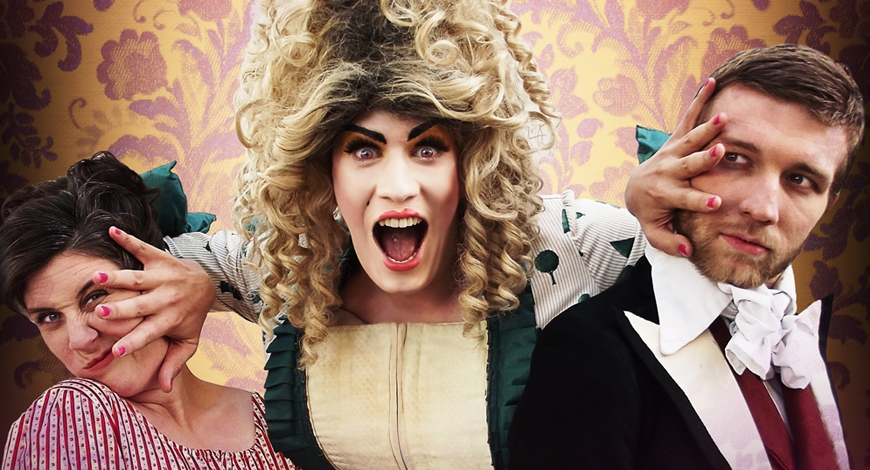
By Jove, despite its loyal adherence to both the novel and the pantomime tradition, brought some very modern aspects to the production which enhanced rather than detracted from its appeal. A small company will always struggle to have a cast the size of Austen’s world, but By Jove made a virtue out of necessity. Mr Bingley was played by a wooden broom in sunglasses propelled around by the Fairy Queen (following the apparent departure of a cast member for the richer pastures of the Great British Bake-Off) whilst the role of Lady Catherine de Bourgh was taken over by the Dame (as Dame Maggie Smith had, apparently, “fractured her spine in sixteen places” just prior to her entrance). By far the cleverest twist was the apportioning of the characters of Mary, Kitty and Lydia Bennet to a single actress, Sheereen Roushbaiani. Critics of Austen often complain that the three younger Bennet sisters are mere cyphers and this was partially acknowledged by Roushbaiani playing Mary whilst representing Kitty and Lydia with hand-puppets. I was struck however by her ability to give all three girls consistent differing personalities, with different voices, movements and tics. Her Mary Bennet, the archetypal middle-child eclipsed by younger and older sisters, was a study in the way shy and unnoticed children will often have multiple personalities and invisible friends and also allowed her to carry the audience, who were united in sympathy for her desire to be allowed to play the piano and sing, the only thing she enjoyed. There was an affecting pathos to this performance as well as great technical skill which makes Roushbaiani a talent to watch out for in the future.
If Mary Bennet was therefore the quiet star of the production, by far the most outrageous was Mrs Bennet. If ever a fictional character was made for a pantomime dame it must surely be Mrs Bennet and this was demonstrated with panache and aplomb by James Walker-Black. Dressed in an eighteenth-century style – which provided an exotic counterpoint to the more muted Regency fashions of the other characters and was perfect for the character of the dame and the age of Mrs Bennet – she pranced like a pony. But like any good dressage horse, Walker-Black gave a performance that was as beautifully controlled as it was hysterically funny, never allowing the laughter or the audience to descend into anarchy. Director David Bullen also produced an excellent turn as Mr Collins, perfectly capturing his oleaginous and fawning character.
Elizabeth (SJ Brady) and Jane (Siân Mayhall-Purvis) shared the role of ingénue in this production with Mr Darcy (Dannie Pye) as principal boy. Mayhall-Purvis was amusing if occasionally over-the-comic-top, something of a contrast to ‘quiet, sweet Jane’ in Austen’s novel, although her essential goodness was still intact. Brady and Pye both suffered from the classic pantomime issue of being the straight actors who provide the ballast to the comic roles and both appeared at times rather stiff – appropriate for Mr Darcy perhaps, but not so much for impetuous Elizabeth. A slight feminist slant came through but the confines of the genre prevented any serious exploration of this nuance, although Elizabeth’s stated leisure pastime of “reading essays on gender by Judith Butler” produced a burst of laughter. However quietness is needed in any pantomime to provide relief from the riotous goings-on and Brady and Pye both provided moments for the audience to think. The ensemble of Elly Lowney, Sinead Costelloe, Ella Garland and Alice Trow were all excellent in their roles of Trish the Maid, Caroline Bingley, Mr Wickham and Anne de Bourgh respectively and also provided a lively chorus and some lovely business and expressions.
Topical cultural references abounded, with Blind Date, Game of Thrones, Poldark and Bridget Jones’ Diary shoehorned into the script – I particularly enjoyed the conceit of Mr Collins being presented to Elizabeth as one of a Blind Date panel, with two volunteers from the audience making up the numbers. Pride and Prejudice: The Panto is described as not suitable for children and after Elizabeth’s question “I am a Christmas Turkey: How would you stuff me?” I could see why! A clever take on the traditional pantomime water-bucket gag between Elizabeth, Mrs Bennet and Trish the Maid saw Mr Darcy thoroughly wet-shirted in a nod to Colin Firth’s turn as Mr Darcy in the 1996 BBC adaptation much to the delight of the female members of the audience, although the shirt, initially, remained on due to the intervention of Lydia’s elopement with Mr Wickham. His small soliloquy “Oh I do wish there was something I could do” was interrupted by an exquisitely timed heckle from an audience member of “Take your shirt off!” Pye, with beautiful hauteur, duly obliged, much to the joy of those present.
The in-the-round performance space and minimal furniture allowed the players to move between scenes with ease, although blocking was occasionally an issue. Costuming was not entirely in period (for example, evening gloves worn with day dresses, a military jacket for Mr Darcy) but perfectly acceptable for the pantomime format, which is a pastiche, not a faithful reproduction. A single piano provided incidental music and accompanied popular songs with One Direction, Black-Eyed Peas and Taylor Swift utilised in a Regency setting. The overall standard of singing was enthusiastic rather than practised, though Mary Bennet, when finally allowed to sing, proved to have a lovely voice and brought the house down with ‘All I want for Christmas is you’. Modern references to Twitter and social media and the appearance of Mrs Bennet at the Netherfield Ball with a selfie stick were cleverly integrated with original dialogue from the Austen text, such as a rather louche moment when Mr Darcy looked set for a spanking in response to Caroline Bingley’s “How shall we punish him, Miss Bennet?” All in all, it was a sparkling production which I would thoroughly recommend – but strictly for adults only.
Regular readers of Criticks will know that we do not often feature pantomime on our pages, despite its provenance in our period. But for scholars of the period, this production somehow manages to encapsulate something of the riotous spirit of the eighteenth century and deliver something that is completely traditional yet entirely modern. If you can, get down to the Cockpit Theatre this Christmas – you’ll enjoy it! Oh yes you will!
Pride and Prejudice: The Panto is at The Cockpit Theatre, London until the 20th of December 2015. Performances daily at 7.30pm with a matinee performance on Sunday 20th of December at 3pm. Tickets are £14/£12 concessions. Groups of more than five receive concession rate and groups of more than ten receive a £10 tickets rate.
Box Office: 0207 258 2925 / www.thecockpit.org.uk.