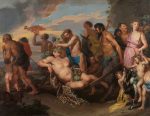
Michaelina Wautier (Royal Academy of Arts)
The Royal Academy now offers the extraordinary work of Michaelina Wautier (1614 -1689), a recently ‘recovered’ late seventeenth-century Netherlandish artist of exceptional talent, whose work has

The eighteenth century was the first great age of criticism. In this spirit, the Criticks website provides entertaining, informative and provocative reviews of events and media that are of interest to scholars of the eighteenth century. These complement the reviews of books that are published in the journal of the Society, Journal for Eighteenth-Century Studies.
Plays, concerts, operas, exhibitions, films, trade fiction, broadcasts and online resources are here considered in depth by experts in the field. If there is an event that you would like to see reviewed in these pages, or if you would like to review for us, please contact one of the editors below:
Fiction: Helen Dallas
Fine and Decorative Art: Miriam Al Jamil
Media: Gráinne O’Hare
Music: Vacant
Theatre: Isabel Azar
The Royal Academy now offers the extraordinary work of Michaelina Wautier (1614 -1689), a recently ‘recovered’ late seventeenth-century Netherlandish artist of exceptional talent, whose work has

This exhibition (curated by Sir Charles Saumarez Smith CBE and architect Roz Barr) is part of the Vanbrugh300 celebrations and accompanies a new biography of Vanbrugh, by Saumarez Smith: the first in
Marie-Antoinette Style reveals that despite her tragic end, Marie-Antoinette remains as fashionable today as she was in eighteenth-century France.

Viewing Sarah Lethieullier’s dolls’ house at close quarters is an excellent experience, and one made all the better for its presentation in the Huguenot Museum.
Although difficult issues of ignorance, exploitation and commercial greed are addressed, the overall sense of this exhibition is one of hope, of the power of gardening and nurturing the land to heal

These three players—Austen, Turner, Harewood—weave themselves in each gallery’s themes, bringing to our attention myriad resonances and surprises.
Spanning a monumental four hundred years (1520 – 1920), Tate’s “Now You See Us” rightfully unveils the works of over one hundred female artists and recovers from oblivion a collection of
The Fitzwilliam Museum’s Black Atlantic exhibition and the British Museum’s Enlightenment Gallery offer other ways of confronting curatorial complicity in colonialist and racist violence... With
The Royal Academy have largely achieved their aim for this exhibition by starting a courageous conversation about ‘art and its role in shaping narratives of empire, enslavement, resistance,
This modest exhibition is narrowly focussed on Angelica and her career leaving many questions still to be explored.