
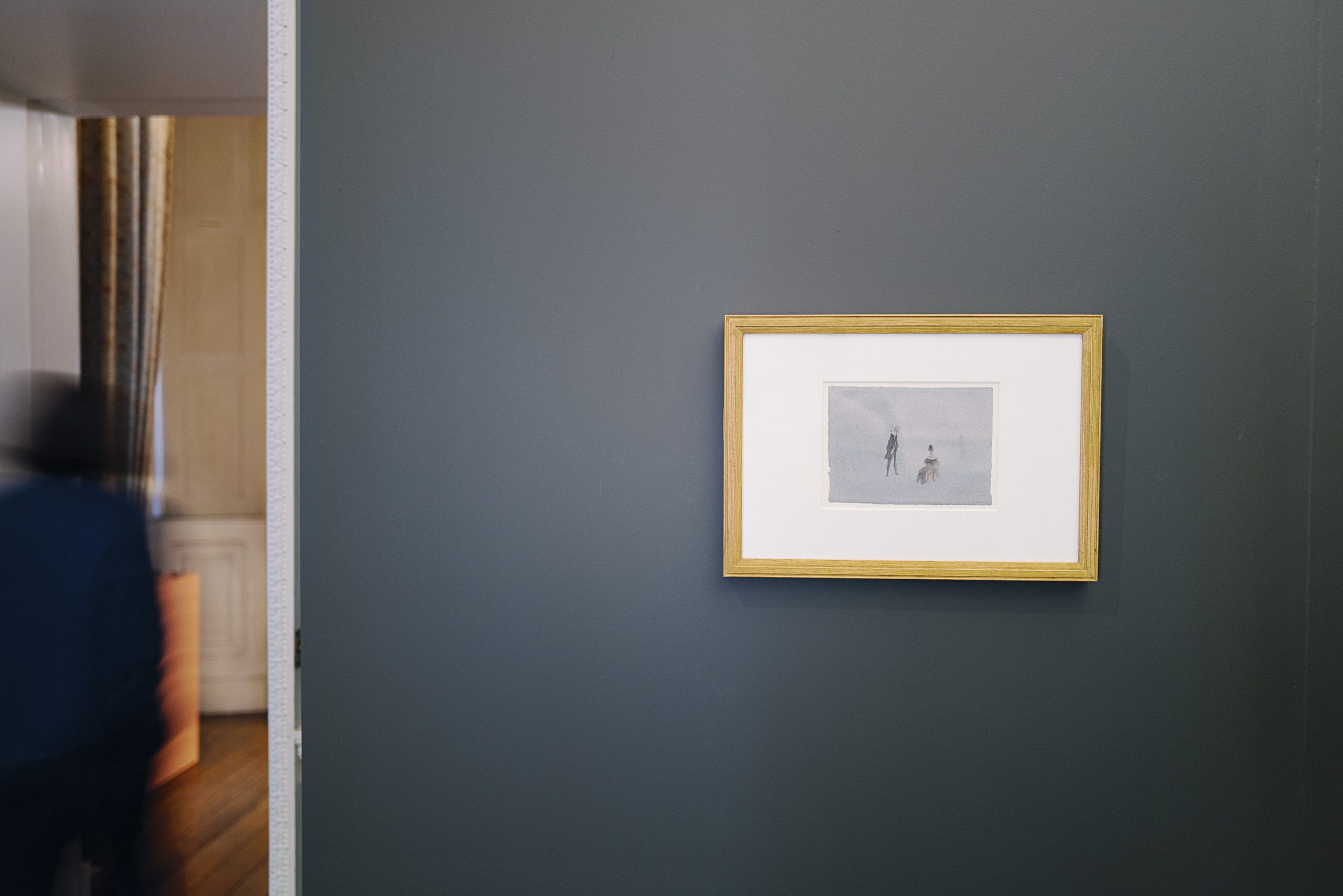
Jane Austen and JMW Turner were born in the same year, 1775. Jane Austen and JMW Turner are also both artists that continue to capture our collective imagination now, perhaps, more than ever.
But what to make of this coincidence of birth year? Austen is seemingly best associated with the Regency drawing rooms, Turner with Romantic land- and seascapes. But their lives—as lived in their works and experiences, their travels and their communities—overlap and intersect in unexpected and important ways: this is the inaugural insight of the powerful new exhibition and associated research project at Harewood House, “Austen and Turner: A Country House Encounter,” a collaboration between Harewood House Trust and the Centre for Eighteenth-Century Studies (CECS) at the University of York and co-curated by Prof Chloe Wigston Smith (Director of CECS), Prof Jennie Batchelor (Head of English, York), Dr Richard Johns (History of Art, York) and Dr Marjorie Coughlan (History of Art, York), with Rebecca Burton (Harewood House Trust Curator and Archivist) and curatorial support from independent curators Jade Foster and Diane Howse.
Consider the founding, palimpsestic image of the exhibition, Turner’s 1827 “Petworth House: Two Figures,” a watercolour on blue paper (image above). Here, as the curators and expert exhibition catalogue draw out, we see lines and figures of intimacy—a man and a woman; she seated with her back to us, he standing and curled towards her. This is from the hand of the young, relatively unknown Turner plying his craft as a resident artist in many of England’s great country houses (in this case, Petworth in Sussex, owned by the 3rd Earl of Egremont). In these lines and figures of intimacy, one also immediately recognizes Austen’s novels, with their characters drawn from those who might visit and occupy such spaces.
In this, then, the third actor of the exhibition emerges: the walls and ceilings, the fittings and furnishings, and the colonial wealth and violence of slavery for which the blue paper in “Petworth House: Two Figures” is a placeholder. As the exhibition instructs, the careers of Austen and Turner were deeply informed by the sociability and material conditions of late eighteenth- and early nineteenth-century country house culture. Austen’s brother, Edward Austen Knight, owned Godmersham Park in Kent, which Austen visited regularly. Turner received the patronage of various country house owners, including Edward, Viscount Lascelles, son of the 1st Earl of Harewood, who commissioned six large watercolours of the house and estate.
The location of the exhibition, Harewood House (1759-1771), was designed by the architect John Carr, with interiors by Robert Adam and furniture by Thomas Chippendale. Owned and built by the Lascelles family, Harewood House was funded by the massive wealth the family acquired through their ownership, management, and interest in (by 1780) of nearly 30,000 acres and two dozen plantations in Barbados, Jamaica, Grenada and Tobago, among other businesses related to the trafficking, enslavement, and enslaved labour of Africans. Theirs is one of scores of “spectacular fortunes” acquired in the West Indies saltwater slave trade, to use Stephanie E. Smallwood’s important phrasing.[1] The family’s last West Indian plantation was sold in 1975. The custodians of Harewood House have, since the 1990s, begun to open the estate’s archives and spaces to document and, in some ways, redress the history of enslavement and colonial extraction that funded the family’s “spectacular fortune.”[2] These three players—Austen, Turner, Harewood—weave themselves in each gallery’s themes, bringing to our attention myriad resonances and surprises.
Organized around four interlocking themes, the picturesque landscape, sociability, empire and slavery, and creative innovation, the exhibition brings objects from Harewood’s collection together with significant objects on loan from other national collections, in the process, bringing new conversations and insights to light. For example, the curators juxtapose Austen’s Sense and Sensibility, bound in leather for Henry Lascelles, 2nd Earl of Harewood, with a first edition of Sense and Sensibility in its original boards (on loan from Jane Austen’s House, Chawton), as well as bringing together Turner’s watercolours of the Harewood House and Estate and his travelling watercolour box (on loan from the Royal Academy of Arts, London). Arguably, the jewel of the exhibition is the manuscript of Sanditon on loan from King’s College, Cambridge. With this item, we are encouraged to imagine that Miss Lambe, Austen’s West Indian heiress, graces Harewood’s drawing room. Inspired by creative, historical approaches such as Saidiya Hartman’s critical fabulation, the exhibition also includes commissioned new works by Writer in Residence, Dr. Rommi Smith, and Artist in Residence, Lela Harris.[3]
For this viewer, one of the most powerful interventions concerns the exhibition’s persistent attention to empire and slavery, both in a dedicated gallery and throughout. The gallery, “Dead Silence,” evoking Austen’s famous phrase in Mansfield Park, gives voice to the pervasive and ongoing Regency debates about abolition and slavery, holding space open for contemporary audience members to recognize that ethical, political, and economic arguments about the enslavement of Africans not only financed country house life, but also permeated it. Sketches by Austen’s brothers recording their travels to the West Indies (such as Francis Austen’s “Coastal Profiles of St. Lucia, St. Vincent and other islands in the Caribbean”) and a sketch of the Lascelles Belle Estate in Barbados all require that we recognize what they refuse to represent, namely, the enslaved Africans and extractive economy of the plantation.
By this remarkable exhibition’s end (an assessment shared by my colleague, Claude Willan), we recognize that the unmarked blue paper surrounding Turner’s “Two Figures” is, rather than a placeholder, a palimpsest for the exhibition itself. Viewers are invited and provoked to fill in those spaces. The exhibition accomplishes this in a straightforward way by including conversation cards for viewers to complete and share. But it also accomplishes this cumulatively as viewers walk and take in the objects and layers of history magisterially brought together in the exhibition. By the exhibition’s conclusion, therefore, we recognize that our challenge, individually and collectively, is to imagine the possibilities of more equitable futures by looking at the past anew.
[1] Stephanie E. Smallwood, Saltwater Slavery: A Middle Passage from Africa to American Diaspora (Cambridge, Ma.: Harvard University, 2008).
[2] See, for instance, S. D. Smith, Slavery, Family, and Gentry Capitalism in the British Atlantic: The World of the Lascelles, 1648-1834 (Cambridge: Cambridge University Press, 2006), 2-7; “David Harewood: What’s in a name? A conversation between David Harewood and David Lascelles” (November 13, 2023) https://www.youtube.com/watch?v=KiPuklu41tw; and Mireille Harper, “Harewood, Slavery and the Caribbean” (15 January 2025) https://harewood.org/stories/harewood-slavery-and-the-caribbean/. My many thanks to Nathan Hensley for recommending Smith’s book.
[3] Saidiya V. Hartman, “Venus in Two Acts,” Small Axe 26 (June 2008): 1–14.