
In 2017 the National Gallery in London purchased The Fortress of Königstein seen from the North painted by the Venetian artist Bernardo Bellotto. It is one of a series of five views, commissioned by the Elector Frederick Augustus II of Saxony and King of Poland (Augustus III), which were never delivered due to the outbreak of the Seven Years War and the seizure of Dresden, the capital of Saxony, by Frederick the Great. The five paintings soon after landed up in England, in different collections, and this exhibition brings them together for the first time since they were painted. Viewed together in this exhibition, the immediate impact is spectacular due to the scale of these eight-foot canvases and the marvelous clarity with which the Fortress of Königstein and its surroundings are portrayed.
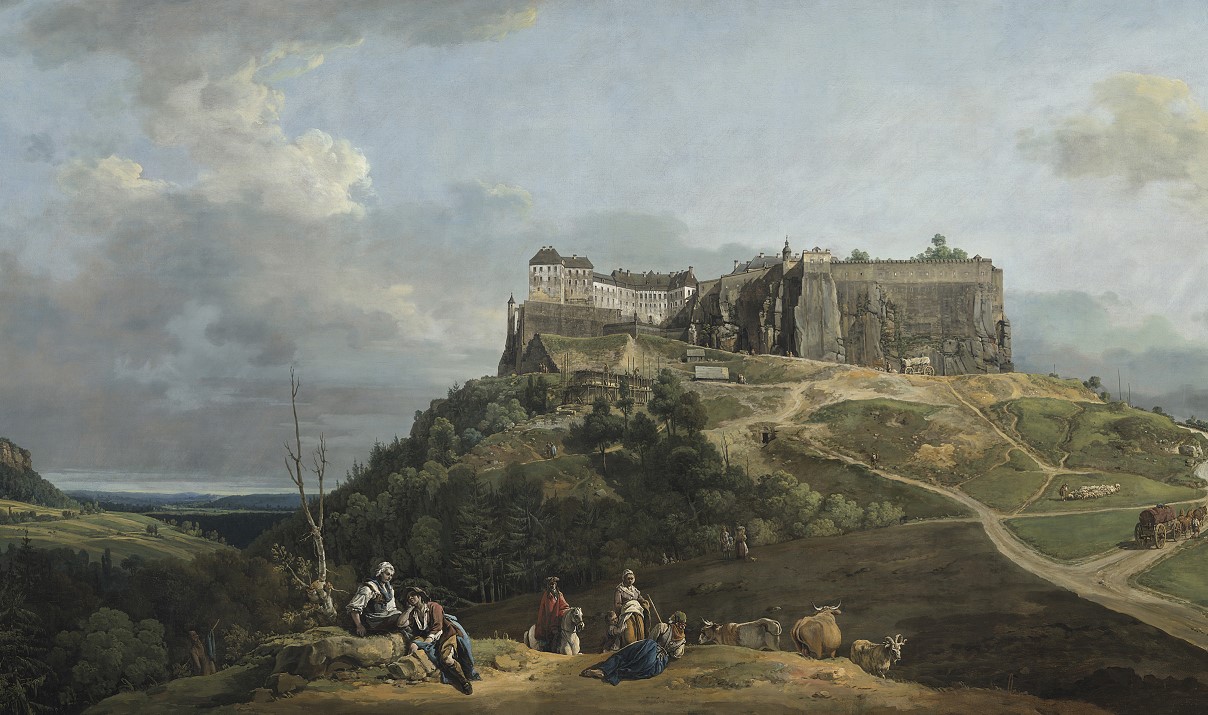
The Fortress of Königstein from the North-West
Bernardo Bellotto
1756–8. National Gallery of Art Washington. Courtesy of National Gallery Press Office Archive.
Bernardo Bellotto (1722-80) was born in Venice and was the nephew of Canaletto whose views of Venice, always popular, are very well represented in the National Gallery. He was trained by his uncle and worked with him in his studio where he learnt to paint views with rigorous precision and a mastery of perspective while both of them recognised the commercial importance of prints after them. They supplied views of Venice, in particular to British aristocrats on the Grand Tour, through the agency of Consul Smith. Bellotto, soon recognised as an accomplished artist in his own right, was marketed by Anton Maria Zanetti who acted as his intermediary promoting him to a variety of clients. For Prince Frederick Christian, the son of Augustus III, who visited Venice in 1739-40, he painted a large view of the Grand Canal, now in the National Museum in Stockholm, which no doubt later helped him to secure a position of Court Painter in Dresden. After Canaletto had left Venice in 1746 for England, Bellotto arrived in Dresden the following year and was soon the highest paid artist at the Saxon Court. He was to produce fourteen large paintings of Dresden for the Elector, together with a second set for his Prime Minister, Count Brühl, and a further eleven views of Pirna and five views of the Fortress of Königstein.
The Fortress of Königstein is built on a massive rocky outcrop of sandstone high above the River Elbe some 25 miles south-east of Dresden on the border between Saxony and Bohemia in an area known as the Saxon Switzerland. It has a long history but the Fortress that survives today was built under the Elector Christian I in the 16th century with further work continued under the Elector Augustus the Strong. The three paintings hanging in the centre of the display represent the exterior of the Fortress from different view-points while the remaining two, hung on the side walls, record the interior courtyards. The Fortress of Königstein from the North (National Gallery) shows the complex of buildings of different periods spread across the site and dominated by the brightly lit Georgenburg rebuilt into a Renaissance style hunting lodge by the Elector George I in 1619. Details of these rather grim buildings, delineated with cool precision against a distinctly northern sky, are relieved by the sunlit pavilion perched on the edge of the cliff-like rocks on the left. The Friedrichsburg, formerly a watch tower, was rebuilt as an octagonal pavilion with a mansard roof by the Court architect Matthäus Daniel Pöppelmann for Augustus III. Across the steep green and wooded slopes below the walls paths leading up to the Fortress are animated with small groups of figures. In the centre, light subtly falls on a pair of cows, one white seen from behind and another contentedly grazing, likewise on a rider on a white horse brandishing a stick. Different hands are evident in the painting of the staffage, many groups having been derived from Dutch prints in Bellotto’s own large collection. Other figures are more Italianate but their character differs markedly from those of Canaletto. Across the foreground is a track leading to the river with a peasant woman carrying a baby accompanied by a child on the right of the painting while a small coach disappears from the scene as it winds around a corner into the distance on the left. Bellotto frames his composition with a tree beside which a figure with a red cap has an outstretched arm and pointing finger towards the scene addresses his companions, one with a white sleeve resting on a mound, in this very grand and compelling picture.
As has been noted, Bellotto took many of his ideas and models for his subsidiary figures from prints, notably the Dutch artist Nicholas Berchem. We are far closer to the atmospheric world of Dutch townscape painters such as Jan van der Heyden than the colourful moving views of Venice, and Bellotto is a pre-eminent master of capturing the quality of light and atmosphere of a northern scene. This is especially evident in The Fortress of Königstein from the North-West (National Gallery of Art, Washington) where it is seen from a greater distance, standing proudly against a panoramic view which includes the Lilienstein, a table shaped sandstone outcrop the other side of the valley of the River Elbe, and with the blueish Lusatian mountains in the distance. Much of the canvas is taken up by the pale blue sky flecked with light grey clouds allowing for the broken light to fall on the trees and open ground beneath the sheer wall of rock. Roofs peep over the crenellated wall of the barracks in contrast to the lighter block of the Georgenburg. The hill on which it stands, partly wooded, is crossed by the access ramp and paths leading to the gatehouse enlivened with small groups of figures and a covered wagon being driven up the track passing a shepherd and his flock of sheep. The monumentality of the scene is greatly enhanced by the contrasting scale of the loosely painted staffage depicted on a rocky plateau in the foreground. Beside a bare tree sit a peasant woman and her companion, while a rider in a red coat and woman and child approach over the brow of the hill.
Similar groups of peasant figures together with cows, sheep and goats populate the shady foreground of The Fortress of Königstein from the South-West (Earl of Derby) which illustrates the vast scale of the exterior of the Fortress and the meticulously painted weathered sandstone rock from which it rises. On 30th March 1756 an Electoral decree had been issued to the bailiff of Pirna, authorised by Count Brühl, that he and his officials should render assistance to Bellotto (who in the document is called Canaletto) while he works on his drawings “around the mountain fortress of Königstein”. Although none of these drawings survive he would have used them in the studio to construct his compositions and to record architectural details. This document also fixes the starting date for the execution of this group of paintings.
By way of contrast, we are given views of the interior of the Fortress by the two paintings The Fortress of Königstein: Courtyard with the Magdalenenburg and The Fortress of Königstein: Courtyard with the Brunnenhaus (both on loan from the Manchester Art Gallery). In both these paintings Bellotto excels in his detailed description of the buildings and gives us a glimpse of everyday life in the Fortress at this date. The Magdalenenburg had been built by the Elector George II in 1621-22 and named after his son’s wife. The upper floors of this large building, which takes up half the painting, were used at this time for entertaining, while in the cellars below one housed the famous 60-thousand gallon wine cask designed for Augustus III by Matthäus Daniel Pöppelmann. Behind is the tower of the garrison church dedicated to St George. In the foreground a wonderful touch is the women and the washing both hung on the line and laid out on the ground and highlighted in the most subtle way only possible as the fruit of direct observation. On the left is the Brunnenhaus and distant view to the blue Lusation hills beyond and the New Armoury facing the viewer. Fences mark out paths and areas of grass, and groups of well-dressed and more humble people engage in conversation in this calm scene bathed in brilliant sunlight.
In the second interior view we are led into the central area past the end of the Commandant’s house, brightly lit, and with every detail of the roof repairs and flaking paint minutely observed. The access road takes one to the Brunnenhaus in the centre of the composition with its pedimented palace façade designed by the French architect Jean de Bodt in 1735. This gives no hint that it houses the deepest well in Saxony sunk in 1566-69 and vital to the life of the Fortress. Behind the Brunnenhaus is the Magdalenburg with its octagonal tower, and beyond the church and its brightly lit porch. The central area is closed off by the long range of the Old Barracks. What is most striking is the Commandant’s walled garden in the foreground separated from the central area by a fence. There are clipped trees and flowerbeds, and a gardener at work contrasts with a well-dressed couple passing the time of day. It is closed off by a battered wall stretching across the foreground of the picture where Bellotto has delighted in painting the state of the rotting plaster and the stones revealed underneath. In front is a seated a sharply observed woman, a dog and a young man. As in all the views of the Fortress there are small groups of people and just visible leaving the scene in the bottom left is a senior military officer wearing a splendid tricorn hat accompanied by two companions in attendance and followed by an exotic figure with a shaven head in Polish national dress. A soldier respectfully bows as they pass.
Bellotto has left many fine paintings of northern cities, amongst them Dresden, Munich, Vienna and Warsaw. However, this exhibition of the five paintings of the Fortress of Königstein displayed together gives one the opportunity to enjoy them as wonderful insights into life in the eighteenth century as well as to assess Bellotto’s artistic achievement in these great paintings of an important historic building which is familiar to so few of us. They are a document of the time in which they were painted because there is so much information embodied in the details of the buildings as well as the variety of people inhabiting them. They emphasise the foresight of his patron, the Elector, who wished to celebrate the achievements of the House of Wettin by a visual record of his capital Dresden, and also of Pirna and Königstein. Unable to employ Canaletto, his successful recruitment of Bellotto more than fulfilled his desire. It is well known how Bellotto’s views have provided invaluable documentary evidence for restoration architects and in particular for the rebuilding of Warsaw after the Second World War.
Bellotto: The Königstein Views Reunited
The National Gallery, London, 22 July – 31 October 2021
Bellotto: Views on a Fortress,
Manchester Art Gallery, 20 November – 27 February 2022