
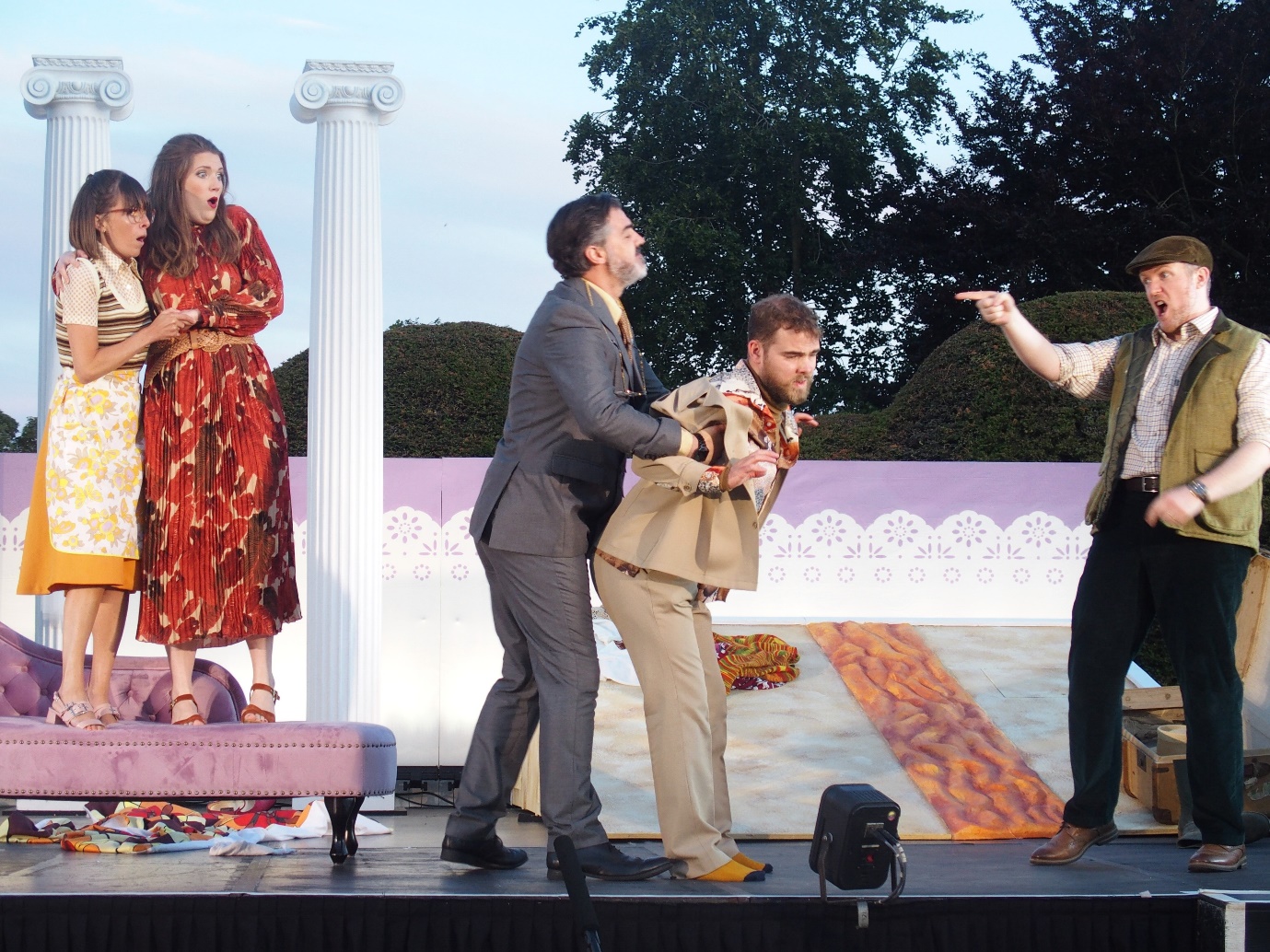
Over the summer Bampton Classical opera performed Stephen Storace’s opera Gli sposi malcontenti, now wittily titled ‘Bride and Gloom’. As usual, they took their garden opera production to St John’s Smith Square, where I caught up with it.
Stephen Storace had links with several areas of eighteenth-century life with which Criticks readers will be familiar. For example, his father, from Naples, was a musician who had married the daughter of the owner of the Marylebone Pleasure Gardens, and he was in charge of the music there. Stephen himself had played the violin in the Marylebone orchestra as a child.
Another link with late eighteenth- and early nineteenth-century life is the fact that the architect Sir John Soane was a friend of the family, having met Stephen’s sister Anna Selina, better known as Nancy, in Italy in 1780. On their return to England, Nancy and her mother were often visitors to Soane’s family at Pitzhanger Manor in Ealing. Pitzhanger itself has recently been reopened after restoration. In the archives at the Soane Museum there are references to Nancy having dinner at Pitzhanger, along with J.M.W. Turner.
Nancy was a famous soprano of the time, and had been snapped up by the Austrian Emperor Joseph II’s agent to form the new Imperial Italian opera company in Vienna. It was due to the admiration that the Emperor Joseph had for Nancy that the opera was commissioned. It was first performed in 1785 (with Nancy taking the lead role) and was fairly successful at the time, with performances in Germany, and in Paris.
As Jeremy Gray has pointed out in the programme notes, Gli sposi malcontenti is a typical Opera Buffa, involving a complex plot with two pairs of lovers who are in love with the wrong person, various shady characters, and a maid who propels the plot along. The librettist seems to have derived several scenes from Beaumarchais’ banned play, The Marriage of Figaro (which was set by Mozart a year later). These elements include a scene in which a character hides behind a sofa, and a finale of mistaken identities set in a garden at night.
What should we expect, musically, from Storace? One review of this production is headed, a bit like the butter/marge dilemma, ‘you won’t believe it’s not Mozart’. Storace does have his Mozartian moments, most recognisable in the trios, quartets, and especially in the finales of the two acts, in which changes in musical direction support the rapid changes in plot, as each character arrives and contributes to the mayhem.
Within the structure, Storace provides each character with at least one individual stand-out aria. All the cast were splendid – fluent, musically shaped, and sung with real verve and characterisation. To my eye, these opera Buffa characters often seem based on commedia dell arte characters, with its use of fixed social types including servants, old men, and lovers. Thus, Eginia’s stalker Valente is the know-it-all doctor character, proud of his academic learning. The tenor Adam Tunnicliffe captured this essence perfectly, notably in the aria Known to Fame in fourteen faculties. This aria displays Storace’s musical wit, in his use of Baroque fugue to symbolise dry academic learning.
The tenor Gavan Ring was Eginia’s husband Casimiro, who spends most of the opera moping, and being bossed around either by Eginia or by his father Rosmondo. Ring’s rich tenor voice was expressive, and made the audience root for him, and his acting captured the slightly worthy and dull characterisation of the rejected lover. The third male voice, Casimiro’s father Rosmondo, was sung by the baritone Robert Davies. His singing had a rich depth to the tone, and this, combined with absolutely clear diction and superb acting skills, made it the highlight for me.
Of course no opera buffa would be complete without a maid, to push the plot along, paralleling Colombina in Commedia dell arte. Here, the maid, Bettina was sung by Caroline Kennedy, with a sweet clear tone, and very effective facial expression, especially in her aria Sweet peace is my only pleasure.
Eginia, sung by Jenny Stafford,had several stand out moments. One of these was her first entry, when she appears alone, introducing us to her emotional dilemma – her longing for her previous love, Artidoro (Ah, in vain I grieve and sorrow). Even at the end of the last act, Eginia is still questioning her position, in a Recitative and Aria, Oh, heaven, dare I go, dare I remain? Stafford sang this long, demanding part throughout with a delicate expressiveness, effectively capturing the emotional battles within. These were of course brought on by the powerlessness of her position, dictated by men, notably her father (not shown on stage), and her father-in-law Rosmondo. Artidoro himself (Arthur Bruce) appears to have moved on from his love for Eginia suspiciously quickly, and is now in love with her sister Enrichetta (Aoife O’Sullivan). These two provide the light relief from the plaintive singing of Eginia and Casimiro.
The singing was supported throughout with stylish playing from CHROMA, with beautifully phrased woodwind and horn obbligati. The simple set worked well, and praise must be given to the movement director, Alicia Frost, who used the stage to convey the complexities of plot, cleverly displaying who loves whom at each particular moment.
Bampton Opera, founded by its two artistic directors Gilly French and Jeremy Gray, is now celebrating its 25th year. Next year’s production will be announced in the autumn. Do go if you get the chance, to enjoy another eighteenth-century rarity sung with joie de vivre by young future stars.
Bampton Opera’s Bride and Gloom was performed at St John’s Smith Square, London on 17 September 2019, and prior to that at venues in Oxfordshire and Gloucestershire.