
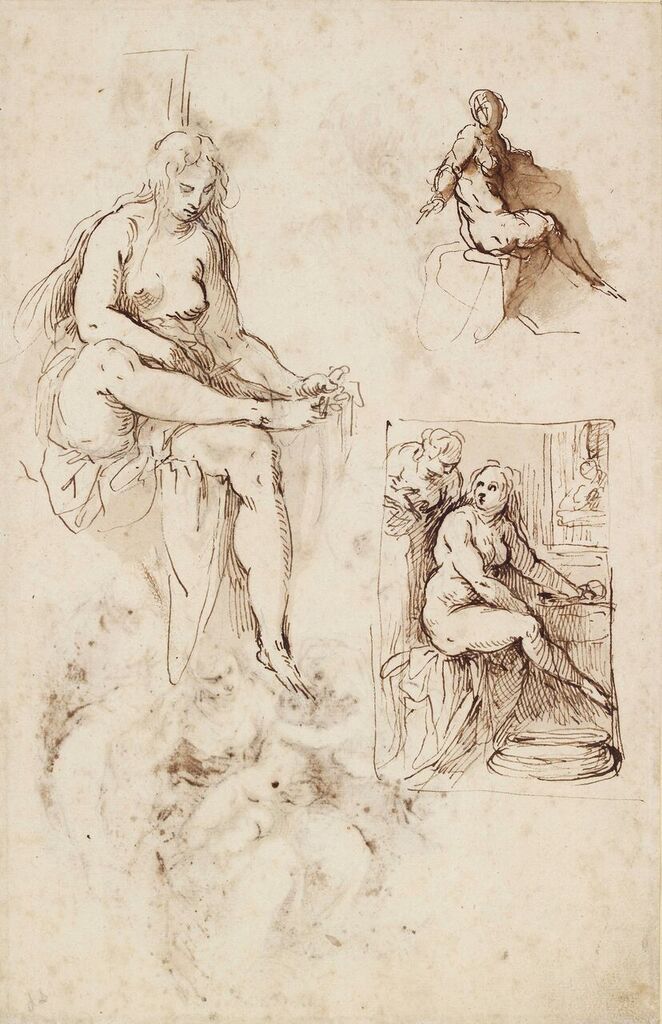
The current exhibition at the Ashmolean is offered as a culmination of the museum’s recent examinations of drawing in all its guises and varieties up to the present day. New work by Jenny Saville which is displayed in an adjoining room specifically engages with the styles and subjects of the Venetian masters shown, and highlights the importance of intense personal observation and the stunning beauty which can be achieved in its translation onto paper. In an era when multimedia interpretations are favoured in art schools, the Ashmolean reminds us of some of the fundamental skills which should inform any artistic practice. Drawing in Venice includes items from the Ashmolean’s collection, Christ Church Gallery in Oxford, and the Uffizi Gallery in Florence where the exhibition will travel in Autumn 2016. The 2,000 drawings collected by General John Guise (1682-1765), who took his BA at Christ Church in 1702, were given to his Alma Mater in 1767, and any trip to Oxford now is enriched by a visit there. A print display accompanies the Ashmolean exhibition at the moment, expanding on the close relationship between drawing and print culture from the sixteenth to eighteenth centuries. In the context of Venetian drawings, we might thus identify and speculate about some of the choices made by this significant eighteenth-century collector and by many other early patrons. Their support ensured the survival of much of the work on display.
The best exhibitions, like the best essays, have a clear argument and impressive evidence to support it. Different threads of inquiry are evident in Drawing in Venice. Crucially, the emphasis is on the techniques themselves. Rather than simply presenting individual artists as masters of their craft, which is often the approach in art exhibitions, we are here shown the family workshop system at the heart of artistic production before an academy was founded in 1750. Jacopo Tintoretto (1518-1594) emerges as one of the most imaginative and innovative artists and teachers in this regard. Giorgio Vasari (1511-1574) asserted in his iconic text The Lives of the Most Excellent Painters, Sculptors, and Architects (1550) that Venetians did not draw. This statement is emphatically challenged by the curator, Catherine Whistler, in the excellent catalogue accompanying the exhibition. It was an assumption which Sir Joshua Reynolds (1723-1792) made in his early Discourses at the Royal Academy, along with many art historians since. We are left in no doubt that this was not true. Perhaps a rigorous reassessment of Vasari should have been an essential prerequisite for art scholars long ago. However, it is interesting that though critical of the Venetians, Reynolds collected their drawings. Examples by Veronese and Tintoretto from his collection feature in the exhibition (Cat.40 Sketch for a ceiling painting, and Cat.48 Study of a nude man in violent action).
Entry to Drawings in Venice is through a passage along which are enlargements from Domenico Rossetti’s three plate etchings after Pietro Liberi’s drawing of Battle of the Fists (1676). It shows a tumult of naked fighting figures on an arched bridge, not in a Classical battle or an image of chaos as we might at first assume, but representing annual battaglioli between two different districts of Venice to assert their rights to control the city’s bridges. It perfectly summarises the energy and carnivalesque spirit of the city, and celebrates the skills in disegno as demonstrated in this exhibition. One of Liberi’s studies which like many of the drawings has not been exhibited before appears later in the exhibition (Cat.76), and we learn that he was rewarded with a large diamond by Louis XIV to whom the subsequent print was dedicated. Along the other wall we follow a map of Venice, enlarged details from spectacular bird’s-eye-view woodcuts by Jacopo de’ Barbari (second state,1514, British Museum) which are set like the folded panels of a screen, echoing the undulating canals and sudden changes of vistas we can experience while moving through La Serenissima by gondola. We journey through three centuries and a variety of subjects, styles and artistic fortunes in the following rooms.
A complex route through the development of drawing skills is traced. The techniques and materials themselves ground the work in the chalk dust and charcoal of the workshops of Venice. The Ashmolean often provides interesting displays to reinforce the practical background of art production, although these tend not to find their way into their exhibition catalogues. Here, we have an imagined reproduction of Jacopo Tintoretto’s ‘box’ in which he suspended wax models of figures, as detailed by his biographer Carlo Ridolfi (see Ridolfi, The Life of Tintoretto […], 1642, trans. into English by Robert and Catherine Enggass, Penn. State Univ. Press, 1984). These were lit in different ways through apertures, for the benefit of his students’ studies. Ceramic artist Steve Rice has constructed a version of this for the exhibition, and it stands surrounded by examples of figure drawing by Tintoretto and his students. These included his son Domenico and daughter Marietta (fascinating details of her life are mentioned by Ridolfi, such as the fact that she dressed as a boy in order to accompany her father in public). The figures and the drawings interact, and as we peer through the box we share imaginative empathy with the students striving to perfect their interpretations.
Nearby, a case shows the drawing materials available, including blue paper which was linked to the indigo used in the Venetian textile dyeing industry. The gradations of texture could hold the chalk and enable subtle qualities to be exploited for effect. A monograph on the qualities and historical uses of blue paper alone would be lengthy, given the details we have on different artists’ approaches, the later Jean-Etienne Liotard’s or J. M. W. Turner’s various preparations and finishes for example. The unfortunate tendency to fade is evident in many of the drawings on display here. The choice of exhibition background colours actually highlights the favoured paper and drawing materials, the grey-blue in the first room and the earth-red in the ‘Baroque’ section of the second room creating subtle associations. The catalogue informs us that in the Venetian tradition ‘red chalk is used with pen and ink as a means of infusing a compositional study with warmth and dynamism’ (p.70). The visitor is encouraged to engage with both the creation and the history of the drawings. Their intrinsic value fluctuated and their survival was more perilous once they had left their studio portfolios.
In addition to studies intended for paintings, artists produced highly finished presentation drawings for patrons. The status of individual drawings as such is often a matter for expert debate. The catalogue entry for Vittore Carpaccio (c.1460-c.1525) The Trial of St. Stephen (Cat.7) states that ‘Carpaccio’s drawings include types of sheets that must have been more common in Venice than we realize, such as the finished composition made to be shown to a patron or a committee’. Re-evaluation of Venetian drawings thus continues to stimulate discussion. The prized examples from distinguished collections on display seem to have been collected for their merit and virtuosity, their original purpose as yet unclear. One case shows two impressive leather tooled and gilded albums, representative of Carlo Ridolfi’s large collection, and General Guise’s, since he purchased some of them. These are part of a display demonstrating the collector’s cabinet which included antiquities, gems and medals and small sculptures. These were not fixed collections, as we are informed that Ridolfi may also have been a dealer. The most prized items were valuable investments and frequently changed hands. General Guise bequeathed Portrait of a Man (black chalk and wash. c.1500), probably by Giovanni Bellini (active c.1459- d.1516), to Christ Church and it opens the exhibition. It has a distinct, compelling presence and high finish but is not associated with a portrait in oil, although it reminds us of his enigmatic young gentlemen, condottieri and doges familiar on many art gallery walls. The catalogue entry notes that it ‘memorably attests to the power of drawing as an art and as an act’ (Cat.1).
A delicate rendering of a young woman (Cat.11) by Titian (c.1485/90 -1576) is placed in dialogue with the Bellini. Her soft youthful features would have been enhanced by the tonal values of the chalk and of the blue paper which is now pale brown, but the quick economical lines suggesting the heavy silk sleeves and stiff bodice over which her loosely-bound hair falls are exquisite in their seeming effortlessness. It epitomises the chiaroscuro for which Venetians became celebrated, in contrast to the expressive line of the Florentines. The influence of antiquities, particularly of Roman sculpture on sixteenth-century artistic production in Florence and Rome, would direct attention towards accurate line as a priority. The exhibition shows many examples of how Venetians imaginatively interpreted classical models, possibly less reverential and more concerned with their dynamic human potential. Jacopo Palma’s (1548/50-1628) page of Studies for Bathsheba at her Bath (Cat. 69) allows us to follow the progression of his life study of a seated model who posed in the act of cutting her toe nails but is reminiscent of a ‘Venus adjusting her sandals’ Roman type. The heaviness of the model is transformed in a small sketch into a spirited twisting figure, her back muscles tensed and head thrown back in an emotional response. A final sketch is outlined to suggest a composition idea, and incorporates the model’s crossed-leg pose and the turning head in a Bathsheba figure, surprised by the sudden appearance of someone behind her. The three drawings, in black chalk highlighted by pen and ink, demonstrate some of the resources used by artists to arrive at an idea: the life drawings, sculptural models and imaginative reworkings derived from them. The same adaptation is evident in Jacopo Tintoretto’s Study of a bust of Vitellius (Cat.55, 56). His drawings of the second-century Roman bust (marble, Museo Archeologico, Venice) infuse nervous life into the marble. His Study after a model of Giuliano de’ Medici by Michelangelo (Cat.50) is a deconstruction of Michelangelo’s Roman military heroic figure, naked and twisting with exaggerated distended muscles rippling down the page. As the catalogue notes, ‘he used drawing as a process of research and a means of acquiring understanding’ (p.130). General Guise owned the last two of these drawings. The exhibition gives evidence of his taste and perhaps the enviable availability of the drawings he was able to purchase through fortuitous connections and astute saleroom decisions.
The eighteenth-century Venetian talent which is evident in work by Giambattista Tiepolo (1696-1770) and Canaletto (1697-1768) is celebrated in the final sections of the display. By then, life drawings were widely collected and a flourishing print trade enabled wider appreciation of Venetian work. Though there is an emphasis on figure drawing throughout the exhibition, this section includes several Ashmolean holdings of landscape drawing by Marco Ricci (1676-1730), Francesco Guardi (1712-1793) and the Grand Tour artist par excellence, Canaletto. His pen, ink and wash Lagoon view with the island of San Michele (c.1742-4. Cat 84) is delicate and unexpected when his ubiquitous canal views in oil are the usual fare in National Trust houses in Britain. The familiar stylised white wavelets give way to flickering reflections in the grey shallow waters of a quiet lagoon shore. The bustle and magnificent architecture of the city is hinted at in the distance, but the foreground features a small villa with its broken wall, hazardous jetty and fishermen whose forms are suggested in restrained outlines. His sketches were prized by collectors in Venice and England, with Consul Joseph Smith his main patron in Venice. Later, Turner’s sketches of the Venetian lagoon would highlight its changing light and mist. The English affinity for watery horizons formed a potent connection.
The contributions of artists, their patrons and collectors are all included in a revelatory display of drawings. Though the oil paintings by many of the artists may be more familiar, it is always satisfying to examine their first thoughts, experiments or alternative work, and to find that many collectors clearly did not take Vasari’s judgements too seriously.
Drawing in Venice: Titian to Canaletto is at the Ashmolean Museum, Oxford until January 10th 2016.