
Glyndebourne has had a special affinity to G. F. Handel since Peter Sellars’s ground-breaking staging of the oratorio Theodora in 1996, and this season we witness another Glyndebourne Festival Opera debut, that of the composer’s 1739 oratorio Saul. In a way a more obvious choice from the composer’s opus than the reflective Theodora, this biblical oratorio not only boasts a highly dramatic action, but lends itself even more to be staged, with its flexible and extrovert treatment of form, structure and orchestration. However, this is not to say that conductor Ivor Bolton and director Barrie Kosky (another Glyndebourne debut) had an easy task. Handel’s oratorios were conceived for the ‘theatre of the mind’ (i.e. concert performance) and drew their innovation from the original London audiences’ active role to imagine, reflect and debate. There were no performance conventions, like in the case of Italian opera seria, to which we can refer to, even if only to distance ourselves from them, as has often been the case with today’s Regietheater. On the musical side, Handel’s choruses, with their monumental musical architecture, are not always suitable to be sung (and conducted) amidst lively stage movement either. It can be said right at the beginning that the creative team at Glyndebourne has tackled these issues with inventiveness and panache, making the challenges work for them, rather than against them.
Kosky has a high reputation in Europe, especially in Germany, the cradle of Regietheater, where he runs the Komische Oper Berlin with equal artistic and commercial success. As testified by the interview in the festival programme, he is no friend of realism in opera. Although Saul would have been perfectly suited for this approach, including a possible temporal and/or spatial transposition of the tragic action (after all, parallels with King Lear abound), the director chose to root the action in a quirky, fantastical world winking at Georgian Britain (perhaps through the lens of Hogarth), but first and foremost verging on the grotesque and the eerie. As in his production of Purcell’s Dido and Aeneas in Frankfurt, the period of creation of the work is evoked not just in some elements of the costumes, but also in the extravagant stage imagery, consciously borderline on kitsch. In Saul, the director justifies well the use of these strong, highly aestheticised images (a few of them elicited spontaneous applause from the Glyndebourne audience) with the play’s progression from festive rejoicing at the beginning to the titular character’s tragic fall at the end. Namely, the first act opens with a luscious banquet, decorated with an oversized 17th-century-style still life to celebrate the death of Goliath, with a sizeable replica of the giant’s head adding a macabre twist to the jubilation. The unsettling impact of these eerie elements continues to grow in the course of the production, as Saul plunges more and more into hate, madness and despair, the bright colours of the opening scenes giving way to an increasingly monochromatic world, culminating in the dense darkness of the Dead March scene. The core of Katrin Lea Tag’s unified set is the imposing black soil, sloping down gently and posing no visible obstacle to the extensive stage movement. The latter was especially impressive in the case of the mass of people represented by The Glyndebourne Chorus, renowned for its superiority in both singing and acting, and merely enhanced in their movement by the witty and charming presence of six dancers (choreography by Otto Pichler). The chorus enchanted the audience with its mix of individualism and homogeneity, integrating elements of revue theatre, breaking the fourth wall by singing into the audience, but also with highly minimalistic and disciplined ritual gestures, matching the musical discipline demanded by some of Handel’s complex polyphonic writing.
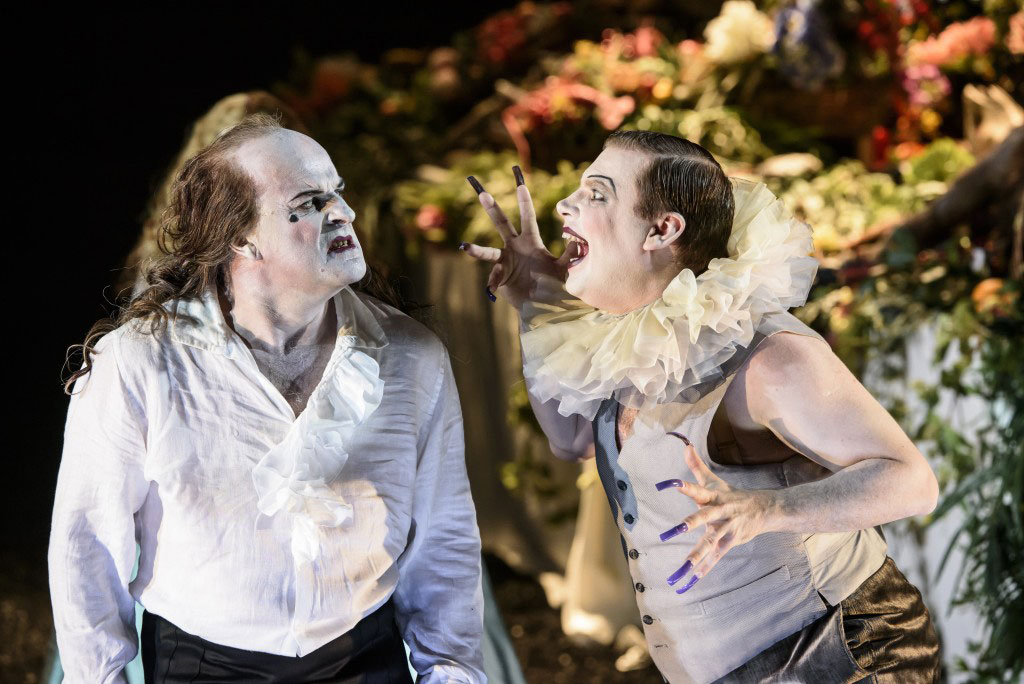
However, the frame they provided would have had little value had it not been filled with strong performances in the individual roles. These were all highly convincing in dramatic terms even if they didn’t always attain perfection in every single musical aspect. John Graham-Hall as the Witch of Endor had a slightly ungrateful task as the stage eeriness reached its climax in the third act. ‘Graced’ with a costume that intensifies the gender-bending of this female role (written by Handel for a tenor and then transposed for a female singer) to the extreme, he sought to find a balance between the creepy and the caricatured in his singing as he breastfed Samuel’s spirit into Saul. More successful miniatures, actually a set of four, were offered by Benjamin Hulett, in whose person Abner, The High Priest, Doeg and An Amalekite were conflated, the first two often to the extent of being indistinguishable from each other. Caricaturing the role of the courtier into a grotesque clown with oversized feet, Hulett nevertheless displayed his multi-faceted talents, especially in the High Priest’s airs and accompagnatos, otherwise often dropped from performances of Saul but here sensibly incorporated into the stage action. Hulett almost outshone the third tenor in the production, Paul Appleby. More lyrical than heroic (as the role requires), and although not lacking in technical precision and musicianship, the young American left us slightly wanting for more vocal edge and resonance, making a meeker impression of Jonathan than Handel might have intended.
The ladies were very convincing in their contrasting roles: the aristocratic, arrogant Merab (Lucy Crowe) complemented the infatuated maiden Michal (Sophie Bevan), who nevertheless acquired stature in the course of the oratorio by saving David’s life and as she laments her father and brother. Crowe is at her most confident in the swift, virtuoso arias, rolling out the coloraturas of ‘What abject thoughts’, ‘My soul rejects’ and ‘Capricious man’ with utmost precision, self-confidence and ease. Although convincing in acting terms as she became more sympathetic to David in Act Two (an accusation sometimes levelled at the libretto), she was less good in the somewhat shrill rendition of ‘Author of peace’. The lapses in intonation in Michal’s introductory aria might be written down to Sophie Bevan’s nervousness, this being the second performance of her Glyndebourne debut. In the subsequent arias the young singer became much more secure. Her rendition of the lament ‘In sweetest harmony’ could have benefited from an extra level of expressive poignancy (more present in her acting than her singing), but it is an ungrateful task to upstage the apex of this in-built funeral anthem for Saul and Jonathan, the solo (for David) and chorus ‘Oh fatal day’, following it immediately.
The two remaining singers in the cast are beyond reproach, offering truly remarkable performances. Iestyn Davies has confirmed his status as one of the leading British countertenors: his expressive amplitude is continuously high, but his singing maintains a level of noble simplicity, especially in the aria ‘Oh Lord, whose mercy’, in which – in this staging – he just about manages to calm down Saul’s mad wrath. His acting was somewhat more evasive, but in line with the production’s take on David as a messianic, out-of-this-world figure quite isolated from all the other characters. The oratorio in general, but Handel’s English oratorio in particular as a genre bypasses the operatic hierarchy of roles, and although the main characters are more balanced in the quantity of music they sing (Saul even getting fewer arias than the younger characters), in a staged performance it is natural that Christopher Purves should claim the most attention in his portrayal of the titular (anti)hero. Although already highly established in the repertory and having sung the role in concert and on disk, Purves obviously relished the challenge of bringing the mad king to life on stage. Under Kosky’s direction a carefully worked out, detailed, and most of all, powerfully moving portrayal of madness took place, starting out as something resembling an epileptic fit but taking on numerous dimensions, from the naturalist all the way to the surreal. Purves plunged into the abyss without fear of taking musical risks, as he did not shy away from tarnishing his otherwise impeccable articulation with explosive breathing and diction, bringing a gutsy physicality to the role that never jeopardised, but only enhanced the superior expressivity of his singing. He was able to steal the show even during the dramatic chorus ‘Envy, eldest born of hell’, his head peeking out of a set of tables and his face contorting as the dancers’ hands graphically depicted the tortures inflicted upon his mind.
The Orchestra of the Age of Enlightenment provided a solid foundation to the singers in a lively and engaging reading of the score. The thin, airy sound of its strings is perfectly suited to the acoustics of a theatre such as Glyndebourne, and the numerous solos benefited especially from being heard crystal clear. The trombones, the timpani, the harp, all these instruments that were somewhat unexpected in eighteenth-century London made as much of an impact as at the time of their creation, especially in the eerie sound of bassoons in the scene of Samuel’s apparition. At some points in the score, when they are treated as soloists, one might have desired a bit more extrovert playing from the oboes or the organ, to match the wit of the illusion of bringing a rotating organ onto the stage during the second act Sinfonia (after all, Handel’s organ concertos did grow out of his oratorio performances), but this restraint might be due to Handel himself, who presumably wouldn’t allow anything to diminish the dramatic impact. This was, obviously, both Ivor Bolton’s and Barrie Kosky’s intention, as well. The former supported the singers and the chorus with a firm, but flexible hand, and the latter chose to tell the story of Saul in terms of his own, predominantly visual aesthetic, but in a way that increased the theatricality and dramatic impact of the music, setting it in a peculiar fantastic world that seemed unique to this production. The result is not necessarily an interpretation of the score that gives the biblical archetypal story a rounded-off, novel ‘reading’, but theatre for theatre’s sake that breathes together with the music.
Saul will be performed at the Glyndebourne Festival Opera from 1st until 29th August 2015.
Image: Christopher Purves as Saul and Benjamin Hulett as Abner / The HIgh Priest in Glyndebourne’s production of G. F. Handel’s Saul. Copyright Bill Cooper.