
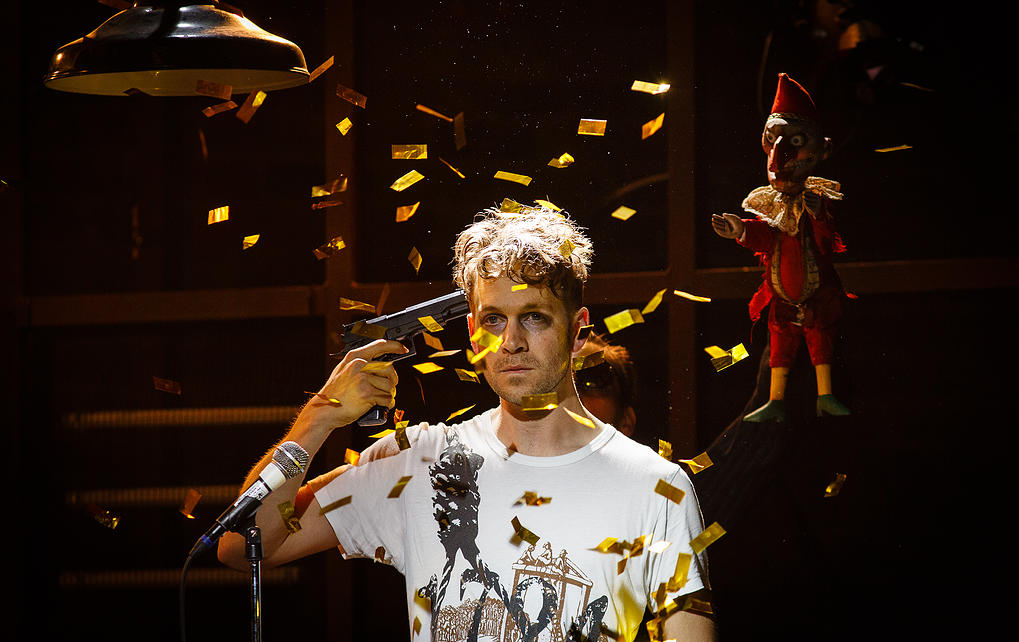
“If you’re a wussy actor, you won’t survive in this show” – so director Mike Shepherd characterised Kneehigh’s adaptation of John Gay’s Beggar’s Opera. He was not wrong: save for a brief fifteen-minute interval, Carl Grose’s script and Charles Hazlewood’s music never stop, hurtling through a corrupt contemporary society from the murder of Mayor Joseph Goodman to the collapse of the Peachums’ ill-gotten business empire.
This is not the plot of Gay’s original work, but references to this adaptation’s predecessor abound: the opening song is still sung to the tune of ‘An Old Woman Clothed in Grey’, and the Greensleeves melody recurs throughout the work, most memorably set to electric guitar in a final apocalyptic number, which retains the lyrics of 1728:
But gold from law can take out the sting;
And if rich men, like us, were to swing,
’Twould thin the land, such numbers to string
Upon Tyburn tree.
Gay, to quote Shepherd once more, wrote an “angry opera of the streets” and many of the objects of his anger translate very well to the twenty-first century. Lucy Lockit is soon to become a single mum, abandoned by Macheath, who is presented here as a hitman whose carefree speech does a poor job of hiding the deep mental scars of a war veteran. Polly Peachum, at first infatuated with Macheath, returns later in this version as his nemesis, her innocence a victim of both her lover’s betrayal and her parents’ double-dealing. As for the older generation, Lockit is (as one rhyming song from the production puts it) firmly in the Peachums’ pocket, while the Peachums themselves are an ambitious and unscrupulous couple, making the most of a society where money is all, even if Mrs Peachum (rather than her husband) is now the brains of the operation.
The Peachums have a set of suitcases. One is stuffed with a bribe to encourage Macheath’s prompt arrest. Another contains Polly’s affairs, hastily packed as she prepares to elope. A third, originally the property of Mrs Goodman, contains Mayor Goodman’s dog, shot by Macheath as part of the play’s opening murder. These suitcases pass across the stage, changing hands both by chance and by design throughout the production, so that they come to symbolise the characters’ emotional baggage as much as their material concerns. Lockit finds a dead dog where he expects to see a bribe. Instead of enough money to fulfill his alimony obligations, Macheath gives a suitcase full of Polly’s clothes to the dancers at the Slammerkin club.
These suitcases are one of many wonderful touches in the production. Another is its use of puppets, particularly for the representation of the work’s eponymous dog, whether the animal is alive, rotting or – in the play’s finale – an enormous skeletal behemoth. Puppets also replace certain characters, vicars and judges, whose strings are now firmly in the hands of the Peachums. Finally, there is the on-stage Punch and Judy booth, whose performances intersect with the events of the show. Back in the eighteenth century, Gay himself may have known Martin Powell’s puppet shows, while – regardless of origin and association – we can all can agree that the tale of a man who betrays his wife, beats a police officer and tricks the hangman is as much that of Macheath as it is of Punch.
The inclusion of puppetry is an innovation born of this show’s long gestation and of the Kneehigh company’s general principles. The company, as their website informs us, aims to create “vigorous, popular theatre for a broad spectrum of audiences.” Their shows begin with an instinct, an urge to tell a story, and draw on all available resources – material and human – to do so. Mike Shepherd, speaking in an after-show Q&A, implored the audience to do as he did and thus “consume the world”: keep a scrapbook of ideas about suitcases, the twists of the Punch and Judy tale, or the way light falls through a window on a late October day. Keep such things, “log it, harvest these ideas” and then “suddenly all this meaning emerges.”
I can’t help but think Gay would have agreed with this. Faced, in the 1720s, with a society newly obsessed with consumption, he consumed his world, harvested it and found an enduring, disquieting meaning there. Kneehigh, dead dog and all, continue the spirit of his work today.
Dead Dog in a Suitcase was first staged at the Liverpool Everyman Theatre in June 2014 and is currently touring in the UK at the West Yorkshire Playhouse (3rd-7th November 2015), Liverpool Everyman (10th-14th November 2015), Bristol Old Vic (17th-21st November 2015) and Shoreditch Town Hall (2nd-12th December 2015). It will then appear at the New Zealand Festival from 26th February to 2nd March 2016.