Shortly after her wedding day, Marie-Antoinette received a letter from her mother Maria Theresa which read, “it is for you to set the tone at Versailles”. Maria Theresa’s words echo throughout the exhibition and recover from oblivion Marie-Antoinette’s pivotal role in the evolution of style in eighteenth-century France. In the face of the scandal and scrutiny associated with Marie-Antoinette’s queenship, it is easy to overlook the extent to which the queen employed any actual agency over the construction of her own public image, let alone the images of those around her. Marie-Antoinette Style reveals that despite her tragic end, Marie-Antoinette remains as fashionable today as she was in eighteenth-century France. The curator, Sarah Grant, successfully restores Marie-Antoinette’s agency and voice, in relation to the changing faces of fashion in eighteenth-century France, and wider Europe.
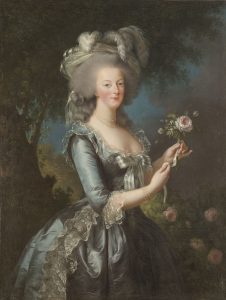
Portrait de Marie-Antoinette à la rose, Élisabeth-Louise Vigée Le Brun © Château de Versailles, Dist. Grand Palais RMN / Christophe Fouin.
Upon entering the exhibition, visitors are transported back in time to the eighteenth-century French royal court. The central room closely resembles the hall of mirrors at the Château de Versailles with its glittering chandeliers and mirror-like cabinets. Soft piano music delights the senses and feeds into the air of opulence and splendour so closely associated with the grand balls of Versailles. One can’t help but marvel at the exquisitely tailored, dazzling silver wedding dress, the wedding gown of Duchess Hedvig Elisabeth Charlotta (later Queen of Sweden) which takes centre stage in the exhibition opening space. This spectacular dress of French silver brocaded silk would have been strikingly similar to the gown worn by Marie-Antoinette on her own wedding day. Popularised bejewelled bodices of the period are showcased alongside sparkling accessories and embellished fragments of court dress, once owned by Marie-Antoinette herself.
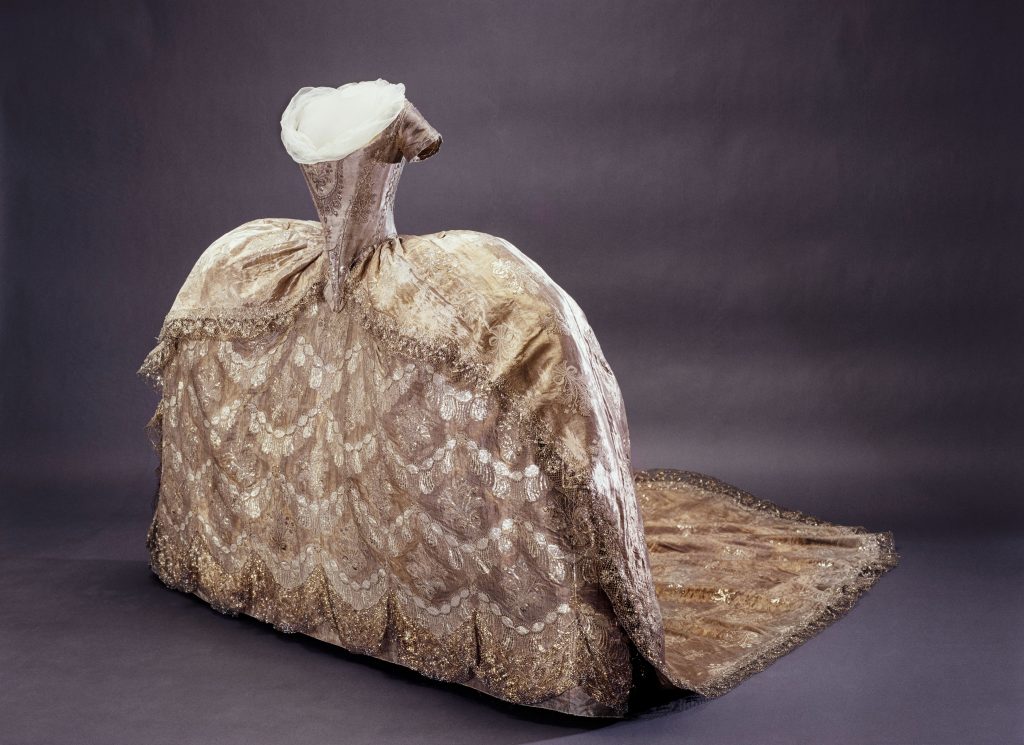
Wedding gown of Duchess Hedvig Elisabeth Charlotta (later Queen of Sweden). Photo: Göran Schmidt Livrustkammaren/SHM (CC BY 4.0)
Moving through to the next exhibitory space, titled, “Queen of Sparkle”, we are reminded of the first of many scandals associated with Marie-Antoinette’s queenship: the diamond necklace affair. A replica of the diamond necklace (the most expensive necklace ever made in France, totalling 2842 carats) is exhibited alongside the Sutherland diamonds. The information board explains that the Sutherland diamonds were ‘almost certainly’ the diamonds from the necklace associated with the diamond necklace affair, which were broken up and brought to England to be sold. The diamond necklace was initially commissioned by King Louis XV as a gift for his mistress, the loathed Madame du Barry. However, Louis XV died before the necklace was complete. While Marie-Antoinette refused the necklace when it was offered to her, a con artist named Jeanne de La Motte fraudulently acquired the necklace and fled with the diamonds. Although Marie-Antoinette remained innocent, the diamond necklace affair marks a turning point in terms of the public’s reproach for her and aligns with the eruption of salacious political propaganda which was already in 1784 being constructed and circulated against the queen.
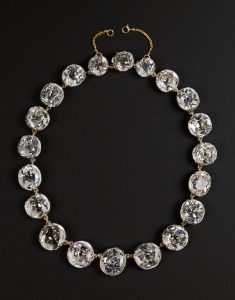
The Sutherland Diamonds, comprising diamond necklace with two additional diamond-set sections. © Victoria and Albert Museum, London.
The overarching theme of the third exhibitory space is centred on motherhood, and Marie-Antoinette’s own transition from wife to mother. Eugène Battaille’s 1868 rendition of Wertmüller’s Queen Marie Antoinette with her two children in the Trianon gardens (1785) is the first image that visitors cast their eyes on, upon entering this space – a portrait which Marie-Antoinette disliked. She recounted that it drew attention to her ‘Austrian’ facial features and commissioned Vigée Lebrun’s Marie Antoinette et ses enfants (1787) to replace it. The gowns on display in this space are less elaborate and more natural in style, reflecting the return to naturalness popularised by enlightenment thinker, Jean Jacques Rousseau (1712 – 1778). Rousseau’s work influenced the construction and reception of the ‘natural woman’ in eighteenth-century France, one of his key revelations was that it was a woman’s natural duty to breastfeed her own children. Contemporary aristocratic attitudes to breastfeeding are embodied in the collection of breastfeeding mothers on display in print and porcelain.
The scandalous portrait of the queen, Elisabeth Vigée Lebrun’s Marie-Antoinette en Chemise (1783) is exhibited alongside one of only two surviving chemises from Marie-Antoinette’s time (this particular chemise was owned by Madame Oberkampf of Jouy-en-Josas). The transition from the earlier ornate and resplendent styles of dress associated with the French royal court to the relaxed natural, corset-less chemise, associated with Marie-Antoinette and her close circle of friends at the hameau of the Petit Trianon signalled a shared sense of egality and liberation among the women who chose to adopt this style.
The exhibition takes a sombre turn in the room titled ‘The Death of the Queen’. Marie-Antoinette’s blood-stained chemise is exhibited alongside the guillotine blade used to execute her, a reminder of the chilling reality endured by Marie-Antoinette in her final moments. The previous exhibitory spaces illuminate Marie-Antoinette’s agency and romanticise the glittering façade of queenship reflected in the elaborately embellished gowns, lavish jewels, grand balls and public spectacles associated with the period. In this solemn space, stripped of her title and of her agency, Marie-Antoinette appears as a powerless mother and widow. The only accessory on display in this space is a medallion containing the hair of Marie-Antoinette and her younger son, Louis-Charles, signalling that her children are all that she has left. Her portrayal as a distraught mother and victim of the Revolution is reinforced in the exhibition of her final note: ‘My eyes have no more tears to cry for you my poor children; adieu, adieu!’.
The exhibition culminates with a celebration of Marie-Antoinette’s fashion legacy, according to Sarah Grant: “Marie Antoinette’s rare combination of glamour, spectacle and tragedy remains as intoxicating today as it was in the 18th century.” Featuring haute couture gowns such as John Galliano’s Evening gown with portrait of Marie Antoinette from the V&A Collection (2006) and Karl Lagerfeld’s ‘Petit Trianon’ dress (2006), this space is evidence of Marie-Antoinette’s lasting influence as an icon of fashion.
Sarah Grant has curated an enchanting, immersive experience that successfully traces the cultural origin, transformation and impact of Marie-Antoinette’s style from 1770 – 1793. The collection of personal objects, portraits and fabrics on display present Marie-Antoinette as a woman, queen, mother and (later) victim, encouraging visitors to weave together elements of the queen’s personal life story. Sarah Grant successfully encapsulates Marie-Antoinette’s reception as a queen of both style and scandal. For Grant, Marie-Antoinette is ‘the most fashionable, scrutinized and controversial queen in history.’ One of the key conclusions that should be drawn from this exhibition is that Marie-Antoinette built a fashion legacy that continues to evolve and influence haute couture fashion today.
Marie Antoinette Style is at the V&A South Kensington until 22 March 2026.