
‘Saturday 23rd January 1754 – I am late to write this diary, but two weeks ago, I had the honour of attending an exhibition at the Royal Academy by Monsieur Jean-Etienne Liotard. He is a painter of Genevan origin, who is much-travelled and is recently returned from the Ottoman Empire. He is in London to paint the Royal children for Princess Augusta. He wears Turkish robes and a long beard and my husband says that none other than Joshua Reynolds himself sees him as a dangerous competitor! The paintings, mostly done in pastels are such beautiful colours. The vivid blue he has painted Mr Garrick’s coat reminds me of a kingfisher in full flight across a bubbling steam.’
(Diary extract of doubtful authenticity, unearthed at the Royal Academy, January 2016)
——————————————————————————————————–
My latest time-travelling experience was at the Royal Academy for its sold-out Masquerade evening as part of the RA Lates series. It was billed as ‘an evening of 18th century courtly decadence, inspired by European Enlightenment artist Jean-Etienne Liotard and his exotic adventures.’ Thus I laced my stays, tied my blue stockings and set off for the Royal Academy in eighteenth-century dress and mask, fully prepared to party like it was 1754.
The RA Lates are specifically designed as outreach events, in that they try to draw a younger and more diverse audience than the traditional RA membership by holding an evening event themed around the current exhibition. Masquerade was themed around the Liotard exhibition in the Sackler Galleries. Reviewing the exhibition was the job of my Criticks colleague Freya Gowrley but I think I can safely say that the old Master was not outdone by his event, my tour of the paintings being the highlight of the evening.
The RA Lates may be aimed at a younger, more diverse audience but it is also a well-heeled one, reflected in the price of the tickets (£22 each, including a free drink) and the additional cost of costuming yourself appropriately. I took a small group of friends, three of us in full Georgian dress and our gentlemen companions in black tie with masks. So fantastic were some of the other costumes that we did actually feel underdressed. Many guests had gone to considerable time, expense and effort for some creations that wouldn’t have looked out of place at Venice Carnival.
Upon arrival, we were presented with maps to guide us around what sounded like some tantalising eighteenth century treats. Some of the advertised activities included Heidegger’s Masquerade Ball, 18th-Century beauty parlour, 18th-century dinner party, life drawing, Enlightenment science talks and Don Kipper, a seven piece band promising ‘Balkan beats’ until late. This was in addition to bars and pop-up food stands. All in all, it promised to be a good night.
Sadly, the promised treats mostly failed to materialise, mainly as the venue seemed massively over-booked and the crush was equal to anything that the eighteenth-century Royal Academy Summer Exhibitions, which began in 1780, could have seen. In fact, so jostled was I whilst attempting to climb the staircase that I was reminded of Thomas Rowlandson’s famous take on the Summer Exhibition when the Royal Academy was still based in Somerset House. Thankfully, I didn’t take a tumble like some of Rowlandson’s ladies!
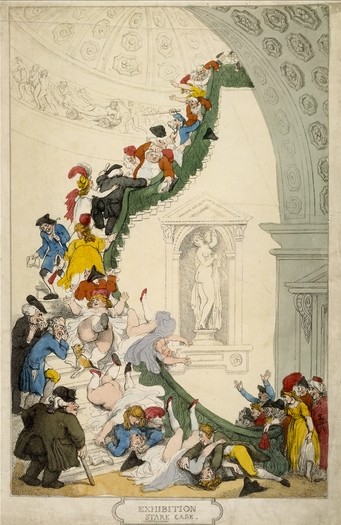
Thomas Rowlandson, Exhibition Stare-Case © The Trustees of the British Museum
The only area of the event which was not a crush of people was, ironically, the exhibition itself. Visiting it soon after the event began, we found ourselves alone with the pictures but for one or two other guests, which felt like a treat in itself and a very different experience from attending the RA during the day, when popular exhibitions are much more crowded. Whilst this was blissful for me, it perhaps says that the audience for RA Lates are not moved by art so much as the chance to dress up and be seen. This, in itself, certainly added a strong eighteenth-century flavour to proceedings.
There were some excellent drinks on offer, based around gin, which seemed appropriate in a Hogarthian kind of way and my group enjoyed chatting over gin in the salon, with the grand surroundings of the Royal Academy making us all feel suitably decadent and in period. But as we attempted to move around the activities, again and again we found ourselves turned away as the activities were full. In particular, we were turned away three times from the eighteenth-century dinner party by a particularly officious member of Royal Academy staff whose attitude would have been more appropriate for members of the mob than the courtly party we presented. We were able to watch the life drawing and the beauty parlour, but were unable to take part. As for Heidegger’s Masquerade Ball, we were barely able to get a foot in the room where the dancing was being held and were reduced to craning our necks to even catch a glimpse of the dancers. I suddenly had a strong sympathy for the middling-sort misses who must have had exactly the same experience at Bath in the eighteenth century, with never an opportunity to look good on the ballroom floor. Deterred, we withdrew for more gin.
In addition to the overbooking, the activities were oddly laid out. The event organisers are obviously constrained by their space, but there seemed some odd choices in both timing and layout. As we arrived in the entrance hall, members of the Covent Garden Minuet Company were attempting to demonstrate dances around the streams of people flooding through the door, leading to several collisions and heated voices. The masquerade ball seemed to be tucked in a small corner of the restaurant, when it would surely have made more sense to place it in the long, elegant room where the life drawing took place. Churn – thinking about the way in which people move around – was neglected, which seemed remarkable given the venue. This led to pile ups and confusion, which was confounded by bad signposting. A tiny, waist-height stand directed people to the Liotard exhibition, meaning that even those who wished to peruse the art the event was honouring had to be very determined or familiar with the Royal Academy gallery layout.
All in all, the evening was not one of my most successful forays into the past – it was, as Mrs Jennings in Sense and Sensibility might say, a ‘sad crush’. Talking to my companions over dinner in a local hostelry after we left the event early (the staff didn’t bat an eyelid at the sudden influx of Georgians), there was general agreement that the RA Lates must draw a regular crowd of London’s beautiful people, for whom the opportunity to dress up and be seen is the reason for going to the event. This, it must be said, must do wonders for the RA visitor profile, but one is left asking, what are the RA Lates for? It seemed sad that what should have been the centre of the evening, the work of Liotard, was rather lost in a froth of glitter and gin.
RA Lates: Masquerade was on the 23rd of January 2016. Upcoming RA Lates include ‘The Garden at Night’ on the 12th of March, inspired by the ‘Painting the Modern Garden: Monet to Matisse’, and ‘Venetian Magic’ on the 14th of May. More details can be found on the Royal Academy’s website.