
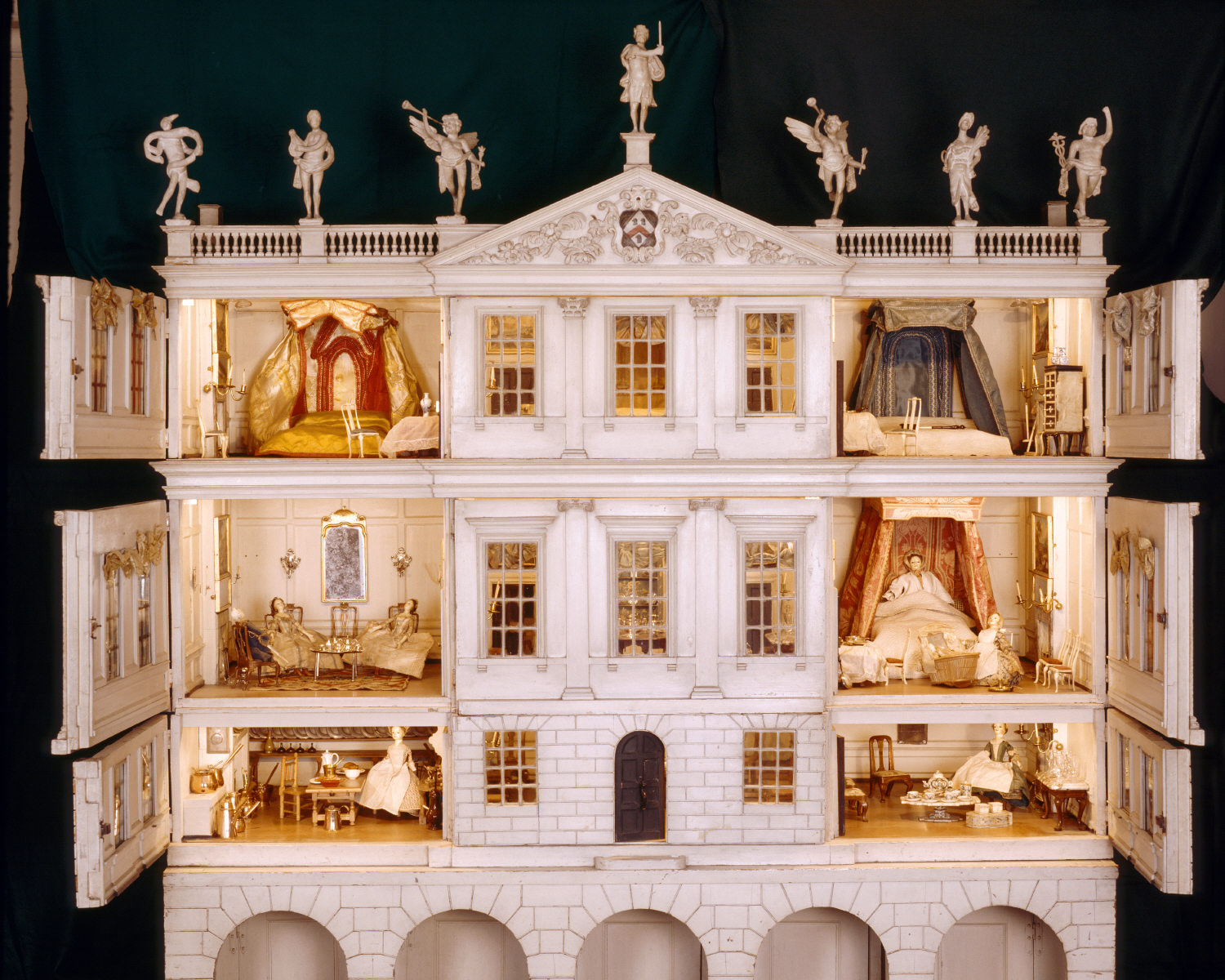
The Huguenot Museum in Rochester is the only museum of Huguenot history in the United Kingdom. Its principal interests are the exodus of persecuted French Protestants to Britain and the subsequent activities of those refugees in British society. Alongside its permanent collection, the museum is currently exhibiting an eighteenth-century dolls’ house which belonged to Sarah Lethieullier (1722-88), the teenage daughter of Christopher Lethieullier (1676-1736), a director of the Bank of England who was descended from Huguenots. Reproducing the trappings of the fashionable elite in miniature, the dolls’ house shows how some refugee Huguenots moved from being pitied as outsiders to take up roles at the heart of British economic and social life.
The Lethieulliers were descended from Jan le Thieullier (1591-1679), a French Protestant whose grandfather was martyred in the 1560s, and who was brought to England by his mother in 1605. Jan’s sons achieved success in overseas trade and eventually became directors of the East India Company and the Levant Company. Family money and his own business interests therefore made Jan’s grandson Christopher a wealthy man. He could afford lavish gifts for his daughter Sarah, and the dolls’ house was probably made for her in the 1730s. When Sarah married Matthew Fetherstonhaugh in 1746, the dolls’ house moved with her to London, and after Fetherstonhaugh died in 1774, Sarah moved it again to the family estate at Uppark House in Sussex. The dolls’ house is now owned by the National Trust, and until the present loan it had not left Uppark for 250 years. Its presentation here, for the first time in dedicated museum space and with extensive supporting information, is a significant curatorial achievement by the Huguenot Museum.
Sarah’s dolls’ house dominates the room in which it is displayed. It is over two meters in height and width, with Palladian-style exterior features, including classical statuary on the roof, and the Lethieullier coat of arms on the pediment. The façade is hinged and opens like double doors to reveal nine rooms across three floors: four bedrooms, a dining room, a drawing room, a hall with a staircase, a kitchen and a parlour. There are dolls representing members of the household, including family, children, footmen and a housekeeper. Most extraordinary is the astounding level of interior detail: upholstered furniture, hallmarked silverware, glassware, crockery, oil paintings, mirrors, kitchen equipment, lockable doors, and real candles with glass hoods to prevent smoke damage. Some items are shown separately in a glass case to allow minute scrutiny. On my visit the case contained, among other things, a tiny drop-leaf table and a marble-topped sideboard, but the contents are rotated and sometimes include the dolls themselves. It is not known whether the house was purchased with some furnishings, or whether the contents were acquired gradually, but there are now around 700 individual items.
The dolls’ house’s striking appearance is enhanced by the method of its display. It is positioned opposite the entrance to its room, filling the visitor’s field of vision as he or she enters. There are relatively few information boards in this room, just some background material about the Lethieullier family and about near-contemporary dolls’ houses in the German states and the Netherlands. These boards are positioned opposite the house, that is, behind the visitor as he or she enters, which means that the information could remain unseen until the viewer turns to leave. Evidently, the exhibition’s goal is to encourage visitors to engage with the dolls’ house themselves, largely unmediated by curatorial scaffolding. In some respects, this is a risky strategy: what might be intrusive instruction for one visitor is a necessary guiding hand for another. But on my visit, the success of the Museum’s display was apparent, with exhibition-goers studying the house attentively, and a few excitedly pointing out small details to each another.
The next room of the exhibition seeks to satisfy those visitors who require detailed explanations. There are display panels with detailed descriptions of the rooms, as well as some lively interpretations by Tessa Murdoch, a historian of the decorative arts and a board member of the Museum. We are told, for example, that an alcove in the dolls’ house displaying silverware is painted blue and flecked with gold to imitate lapis lazuli. And we are shown how the dolls’ gold-threaded attire approximates contemporary fashions. A disadvantage of presenting the dolls’ house and detailed information about it in separate rooms is that it can require repeated trips back and forth. Personally, I found it instructive to return to the house to see previously unobserved details, but some visitors on my trip merely glanced at the detailed information and left without viewing the house again, perhaps discouraged by the extra effort required. On balance, however, the exhibition layout succeeds because it allows visitors to curate their own experiences more effectively. Those who want detail about the dolls’ house can find it easily, but the weight of that context does not overwhelm one’s first impressions, and therefore visitors seeking an aesthetic encounter free from scholarly baggage can also enjoy their experience. The problem of museum annotation is difficult: whatever detail one provides will be too much for some and too little for others, but the presentational strategy here navigates this conundrum effectively.
The exhibition also makes a clear argument about the dolls’ house’s purpose. According to the National Trust page on Sarah Lethieullier’s dolls’ house, its practical uses remain mysterious. It probably was not a plaything, partly because it is in such excellent condition, and partly because the dolls themselves have unarticulated limbs and cannot be posed. An alternative possibility is that the house was used to instruct its young owner about the running of the household. Sarah’s house, however, lacks key service areas and so the National Trust page regards this purpose as unlikely. A third hypothesis is that the house is a showpiece, a ‘display of wealth and taste to be admired’. The present exhibition is more confident and states that the dolls’ house was a teaching tool that helped Sarah understand, among other things, the role of servants, how to heat and light a house safely, and how to dress in polite society. The exhibition even declares that ‘Sarah’s teenage education in managing a great house […] had successfully prepared her for adult life’ as a wife, mother, and member of the gentry. Clearly, there are some significant questions here about play and education in the eighteenth-century, and particularly about how wealthy families inculcated ideas of rank and responsibility in their children. These questions are especially apposite for the Lethieulliers because, of course, they were not aristocrats of medieval lineage, but third and fourth generation immigrants who owed their lands and titles largely to commercial and financial aptitude. Having made a bold argument about the dolls’ houses purpose, the exhibition could have explored these questions further, perhaps drawing on the booming scholarship on eighteenth-century childhood. Moreover, Sarah’s adult life rather fades from view in the exhibition’s narrative. We are told about her and her husband’s Grand Tour from 1749-51, and about her forward-thinking in inoculating her children against smallpox. But more about the trajectory of her subsequent life would have substantiated claims about her successful education and the purportedly foundational role of the dolls’ house.
The two rooms devoted to the dolls’ house take up half of the exhibition space in the Huguenot Museum, and it is perhaps useful to summarise what else the Museum contains. The first room provides a brief overview of Huguenot history from the first use of the word in the 1560s to Louis XIV’s reinstatement of state persecution in 1685, an act which prompted many Protestants to flee France. A second, much larger, room focuses on the circumstances and consequences of this diaspora. The exhibition is very strong on the experiences of oppression and displacement, but it is less clear on the background to that persecution. We are told relatively little about the issues at stake in the Reformation, the reasons for Louis XIV’s abandonment of religious tolerance, or how the Huguenots became a cause célèbre for Protestant countries hostile to France. This means that when we are shown a prayer book small enough to be hidden up a sleeve, or a Bible purportedly baked into a loaf of bread for transport or safekeeping, there is little sense of why it was controversial to possess these objects. The exhibition enables visitors to empathise with people who are mistreated and driven to desperate lengths, but it is less good at explaining why religion mattered so much to early modern Protestants and Catholics alike, and how those convictions drove the domestic and international politics of the period.
The exhibition is firmer on the economic and social consequences of the Huguenot diaspora. The exodus of so many skilled tradespeople deprived France of both craft skills and commercial acumen, to the benefit of their geopolitical rivals. Some of these consequences were very significant. Huguenot descendants, for example, were involved in the creation of the Bank of England, which served to bolster public finances and helped facilitate Britain’s emergence as a great power in the eighteenth century. Huguenot craftspeople also produced luxury goods, and in this way became central to a growing demand for fashionable goods as Britain became rich from overseas trade, conquest and exploitation. On display here are finely wrought silver communion items, delicate pocketwatches, and beautiful taffeta fabrics.
It is from the cabinet of Huguenot-made objects that the visitor enters the room containing Sarah Lethieullier’s dolls’ house, and the sequencing enables a distinct interpretation. If viewed in the bedroom or nursery of a country retreat, the dolls’ house might seem simply to be an extravagant display of childhood privilege. But in the context of the Huguenot diaspora we can appreciate more fully how social elites are formed, how families rise and fall on the political and economic wheels of fortune, and how yesterday’s penniless immigrant can be tomorrow’s magnate bearing marvellous gifts for his daughter. Viewing Sarah Lethieullier’s dolls’ house at close quarters is an excellent experience, and one made all the better for its presentation in the Huguenot Museum.
Sarah Lethieullier’s dolls’ house is at the Huguenot Museum until December 2026.