
There is nothing intrinsically childish or innocent about the miniature world of the doll. Frances Glessner Lee used small, detailed models of crime scenes which included blood-stained victims to revolutionise the teaching of forensic pathology at Harvard in the 1940s and 50s, and the artist Marc Giai-Miniet explores the human psyche through his weird and disturbing dolls’ house creations which are certainly not for children. An initial association with the term ‘A doll’s house’ might be Henrik Ibsen’s psychologically complex play of that name, whose early audiences would have known that the term ‘doll’ usually denoted a pretty, vacuous woman or prostitute, as was the case from the late eighteenth century.
The use and subversion of the doll by artists has a long history, notably exemplified by Hans Bellmer in the 1920s, Jake and Dinos Chapman particularly in the first decade of this century, and currently by Ydessa Hendeles at the ICA in London, (From her Wooden Sleep, 24th March to 17th May 2015). What we might describe as a doll was not exclusively for the use of the child in the eighteenth century. It had a practical and commercial use as a lay figure for artists and as a means of easily demonstrating the latest French fashion for foreign buyers.
A much simpler, more endearing approach to the dolls’ house is appropriately taken by the curators of Small Stories: At Home in a Dolls’ House at the V&A Museum of Childhood, its location precluding any dark, cultural references, we might suppose. This is not entirely the case however, as I will detail below. Interestingly, Ydessa Hendeles states in the catalogue for her exhibition mentioned above that her collection of manikins and lay figures ‘are staged to tell a story’, that they ‘explore the dynamics of the individual in relation to the community.’ This could equally apply to Small Stories, since each dolls’ house is displayed within settings that include historically-specific social and cultural material. For example, copies of the same type of ‘Dutch doll’ which Hendeles’ exhibition features appear here dressed and in context. The doll or manikin is thus an adaptable surrogate for a story-teller, and in Small Stories both the child owner and the dolls themselves communicate their stories to the visitor. Although the exhibition spans three hundred years through twelve dolls’ houses, the examples dating from the eighteenth century will be the focus of this review.
If you have not visited The Museum of Childhood before, you may be surprised by the vast size of a building dedicated to the small-scale and the intimate, qualities which we usually associate with childhood memorabilia. Its iron structure is familiar from early prints of the South Kensington Museum and its Great Exhibition displays. The whole building was transported to Bethnal Green and opened in 1872 as an East End branch, but the V&A childhood collections were only permanently housed there from 1972. It has developed into a lively child-oriented space but with much scope for adult nostalgia.
Since the 1920s the museum has been collecting dolls’ houses, and the best have been used for this display. When school groups have left, the visitors lingering in Small Stories are mainly women, while an occasional small child flits between cases to press audio and light buttons. The static interiors of the houses might seem alien and dull to them, viewed through glass cases. Video games such as The Sims exploit the same urge to create imaginary worlds but with the advantage of immersive interaction and agency. This highlights the central paradox: the ‘small stories’ are those of childhood, but of the childhood of the past, requiring an adult’s historical awareness to give them meaning. This is particularly apparent with the first dolls’ house we encounter, though confusingly its function was actually that of a wardrobe.
A wall is dedicated to framed ‘portraits’ of the storytellers. Most show the dolls posing, but the first is of an eighteenth-century child, labelled ‘Antonia’, who is not identified further. She is associated with the Joy Wardrobe, a cupboard constructed in the form of a house by Edmund Joy in 1712, and known to have been owned by Dorothy Trafford of Goodrich Court by 1912. ‘Antonia’ tells her story on the audio track accompanied by the wall label giving a specific time to convey immediacy, a privileged peek into a captured moment: ‘11.10 a.m.,Tuesday 16th February 1712; Hopes and Dreams; Hiding from the grown-ups, Antonia thinks about her future. She dreams of having a home of her own, but at what cost?’ What follows is a child dreaming of a big house ‘filled with music and dancing’, but she is afraid that the marriage being negotiated for her will result in a life like ‘a songbird in its little cage’. She voices her fears about giving up all she owns in exchange for what may be either a palace or a prison, wistfully confiding that ‘In here I can hide from my fate just a little longer. Just play a little longer’. The dolls’ house is presented as an imaginative retreat from the menacing real world, in which she seeks comfort. In this case, the child is visualised as physically inhabiting the space, the wardrobe that would later represent entry into an alternative world in C.S. Lewis’s fiction, known perhaps by young visitors. ‘Antonia’ takes the role of both doll and owner, looking out but also inwards to confront her anxieties.
The familiar literary trope of the bird’s cage has been researched, drawing for example on the early letters in Samuel Richardson’s Clarissa. We are encouraged to engage with issues of women’s marital status and property rights at a time just before different attitudes towards companionate marriage were emerging. The innocent and short childhood world is presented as under threat from the beginning. Reproductions of samplers, country house prints, the anonymous print The Tea Table (London, 1720), and backdrops of early flowered wallpaper and country house garden design set this display thoughtfully within its period. However, it is unlikely to be fully appreciated by young visitors whose understanding of historical context will be limited.
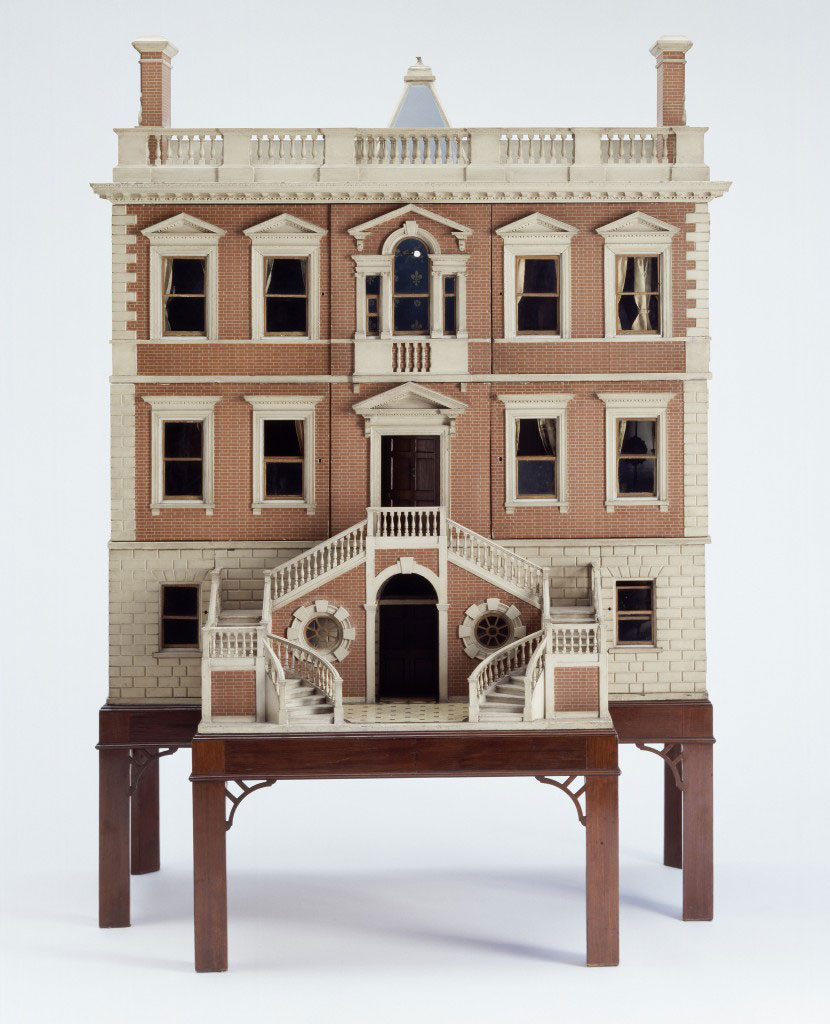
The second eighteenth-century display is of the Tate Baby House from 1760, which boasts original wallpaper and panelling in Robert Adam style. The word “baby” was used in the sense that might now more often describe small vegetables, an adjective denoting size in contrast to the possessive noun “dolls’” in “dolls’ house”. This is significant when considering the usual eighteenth-century perception of the Baby House as a preparation for girls’ anticipated domestic duty and household management, rather than as an imaginative escape from it as told in Antonia’s story. The extent to which this function was assumed is apparent in the montage introducing the exhibition, which shows the rental contract agreed between twelve year-old Margaret Alsager and her father in 1837, stipulating certain rules with regard to the upkeep of her dolls’ house and the rent to be paid. She was not therefore granted ownership.
The Tate Baby House passed from mother to eldest daughter for several generations. In this display three generations of dolls themselves ‘talk’, reflecting on new wealthy middle-class aspirations and taste, their pride and confidence, and on new fashions. For example, the expectant doll called Joanna writes to her mother in 1795 (a reference to epistolary literary style), and mentions that she will employ a man-midwife ‘…in case of trouble’. She is shown in a bedroom with an empty cradle. Clearly, careful curatorial work has resulted in important snapshots of historical insight which are particularly familiar to scholars of women’s history. The interiors of the houses draw us in to identify miniature items of furniture, chairs lined along the wall as in a Hogarth painting, tea sets, books and paintings, material culture which tells its own additional story of acquisition, reproduction, class and status.
The exhibition moves on to a fashionable town house of 1828, exquisite Victorian and Edwardian specimens and into the twentieth and twenty-first centuries, before ending with contemporary artists’ imaginary miniature rooms. There is a wealth of material on the museum’s website, including the audio recordings which are difficult to hear in front of the displays. Great effort has been made to encourage children to engage with the stories: the cases are at child-height, though the wall labels are quite high. It would be necessary to talk a child through what they are seeing. For adults, particularly women, it would bring back personal memories of seemingly endless afternoons absorbed in a precious world of the imagination.
Small Stories: At Home in a Dolls’ House, is at The V&A Museum of Childhood, Bethnal Green, London, until 6th September, 2015.
Image: Tate Baby House (England 1760), Victoria and Albert Museum, London