
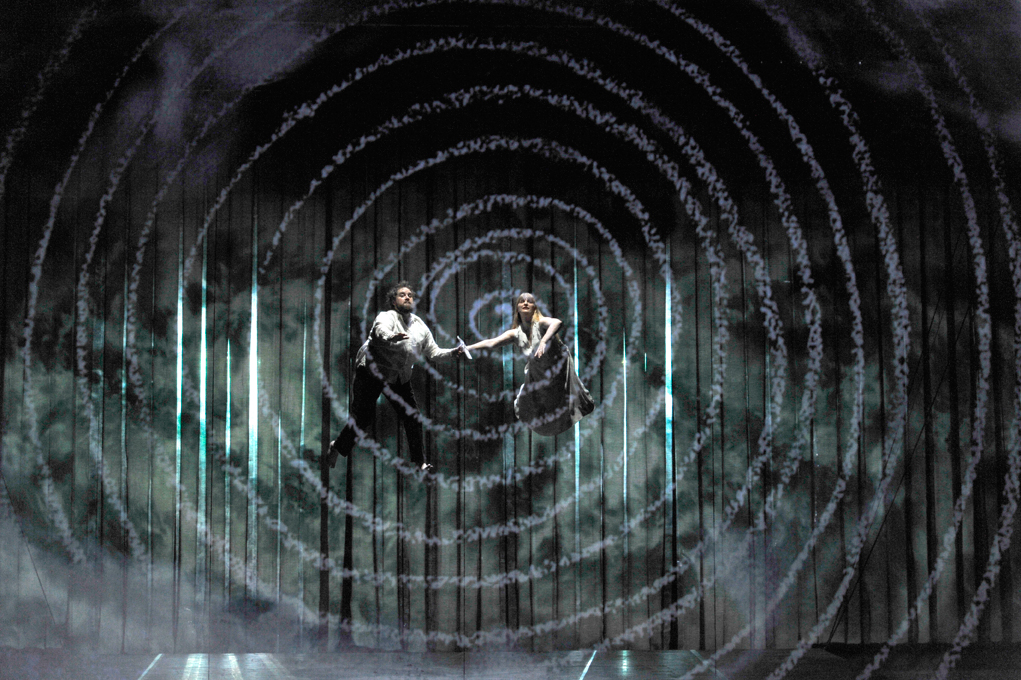
This spring’s Magic Flute at the London Coliseum is the revival of ENO’s original 2013 production in collaboration with the theatre company Complicite, directed by Complicite’s co-founder Simon McBurney and conducted by ENO’s newly appointed musical director Mark Wigglesworth, with ENO Orchestra and Chorus.
Enchanting artificiality. A few moments into the opera’s overture, a young man dressed in black walks out of the orchestra’s ranks with a blackboard in his hands. Rather than a character from the opera’s plot, however, he soon reveals himself as a video performer, taking a seat at the far left corner of the front stage. Here a camera is prepared to film what gets written with chalk on the blackboard, projecting it live onto the stage. The opera’s title, the contour of a rocky landscape, and the indication ‘prince Tamino’ (with an arrow pointing to the singer arriving on stage) are all drawn and then wiped out following the musical gestures of the overture: first with a resolute line, then with a hesitating stroke, following a climax, and so on. Throughout the production these live video projections are captivating, especially because their making is visible. The mechanism that produces the effects – and makes ‘the magic’ happen – is shown, even performed, engaging directly with the audience. Such ‘performed artificiality’, however, does not break the spell but reinforces it. The liminality of video and sound-effects stations at the edge of the stage appears to blur the invisible boundary between the story represented and the real life of performers and the audience. The impression is that everything is magical and fictional. Life is a fairy tale and we all know it.
Music made theatrical. Under the secure hand of the house conductor Mark Wigglesworth, ENO Orchestra gives a compelling rendition of Mozart’s musical charms. ENO’s distinctive, compact orchestral sound bends effortlessly to depict the score’s fast alternation of musical characters, ranging from the eerie to the playful. The dynamic contribution of the orchestra in shaping the spectacle is made ever more vivid by the director Simon McBurney’s choices of raising the pit and devising a great deal of theatrical interaction between characters on stage and instrumentalists in a complicit, powerful storytelling. This ‘theatrical complicity’ can be appreciated especially in scenes involving on-stage music, such as those featuring Tamino’s magic flute or Papageno’s bells. In most productions the singers/actors pretend to be playing themselves, while sound is produced by instrumentalists hidden in the orchestra’s pit. Here, however, the orchestra’s flutist and percussionist are admitted on stage and physically dragged into the action. They get the magic instruments directly from Tamino’s and Papageno’s hands and perform them on their behalf. Not only is the musicians’ presence acknowledged by the characters, but they even become part of comic miniatures involving both the video or noise performers as well as members of the audience. Such metafictional breaking of the ‘fourth wall’ resonates strongly with cultural practices around singspiel performances in Mozart’s Vienna, where solemn scenes were intercalated with impromptu spoken pantomime. Mozart himself recounts in a letter to his wife (9 October 1791) a performance of The Magic Flute when he jumped onstage from a box and played some unexpected chords at the glockenspiel to tease his friend Emanuel Schikaneder – the first Papageno – amidst the audience’s laughter.
Darkness and the light of reason. The entire opera revolves around the opposition between an old regime – ruled by religious superstition and the uncontested power of kings or queens – and a new egalitarian order brought forth by the rationalistic thinking of the Enlightenment. Completed only two years after the beginning of the French Revolution, The Magic Flute can be read as an allegory of the ideals and hopes at the basis of these social upheavals. The evil of the ancien régime is personified in the plot by the suitably named ‘Queen of the Night’, often identified as a representation of the Empress Maria Teresa in her ambition for absolute power. A rather unique and praiseworthy feature of this ENO production is its portrayal of this character. The coloratura soprano playing the role (Ambur Braid, a young promising artist at her UK debut) is disguised as an elderly lady on a wheelchair, wearing a worn wool sweater. This picture has nothing to do, say, with the iconic figure of the soprano Diana Damrau in the spectacularly terrifying and powerful character built for her by David McVicar in a recent (far more traditional) production of the Royal Opera House. McBurney’s conception emphasizes the Queen’s impending doom, the approaching end of an era apparent in her deteriorating health. This Queen of the Night is surely fierce, but more and more self-consumed by the obduracy of her beliefs. She convincingly spits out the high notes of her Act II aria as the last cry of a selfish, domineering grandma. In ENO’s Magic Flute this aria is, in other words, reintegrated in the dramatic narrative, and not treated as the old warhorse we all expect to showcase the singer’s prowess. Rather than celebrating the star system, ENO offers us a fresh, daring reading. McBurney’s Queen of the Night is both formidable and ridiculous: a provocative parody, mocking the ancien régime as much as today’s high-end operatic culture.
ENO’s crisis in the mirror. It is not by chance that the trailer of the aforementioned Royal Opera House’s production is entirely centred on Diana Damrau’s flawless vocal rendition of the Queen of the Night. That is possibly the production’s selling point for many attendees and, on the funding-side, one of ROH’s biggest expenses for its Magic Flute. The ENO production shows a radically different set of priorities. Here opera is, too, a spectacle of the highest quality, but is widely accessible since it is sung in English and with a uniquely theatrical take. ENO’s fresh, creative vision in the past decade has dared where other opera houses have not, and we need it to keep playing such a crucial role in UK’s cultural life. In February last year, the Arts Council of England cut ENO’s funding by 29% (£5m), in effect dropping the company from its national portfolio of organisations for 2015-18. As I am writing, my phone’s news feed pops up the disconcerting news of Mark Wigglesworth’s resignation as ENO music director. In the past months he had made no secret of his discontent with the ENO chief executive’s decision of creating a part-time season – even only temporarily – to avoid bankruptcy (ENO is due to announce details of its new season in May with eight productions instead of this year’s eleven). In his letter of resignations to the musicians, Wigglesworth warns that ‘the company is evolving now into something I do not recognise’. This Magic Flute certainly showed the company at its absolute best, but might this be the end of ENO as we know it?
The ENO’s Magic Flute was at the London Coliseum from 5th February to 19th March 2016.