
The Witlings was written by Frances Burney in 1779. The play is a comedy of manners, but while it was read privately to close friends and family, including Samuel Crisp, it drew alarming parallels to some of the family’s social circle, and in particular, the Bluestocking group. On the advice of her father, Dr Burney, who risked losing his reputation as a result of any potential scandal, Burney never published the manuscript. She later wrote to Crisp, suggesting changes to the play to move the story away from any real-life associations, but unfortunately the play would not be publicly performed until the 1990s.[1] Adapting the play for our modern pandemic world and performing on Zoom, First Flight Theatre Company, in the hands of director Karen Eterovich and stage manager Abby Farber, have managed to recapture the joy of Burney’s rarely performed play, and recreate the intimacy of a private performance through this virtual medium.
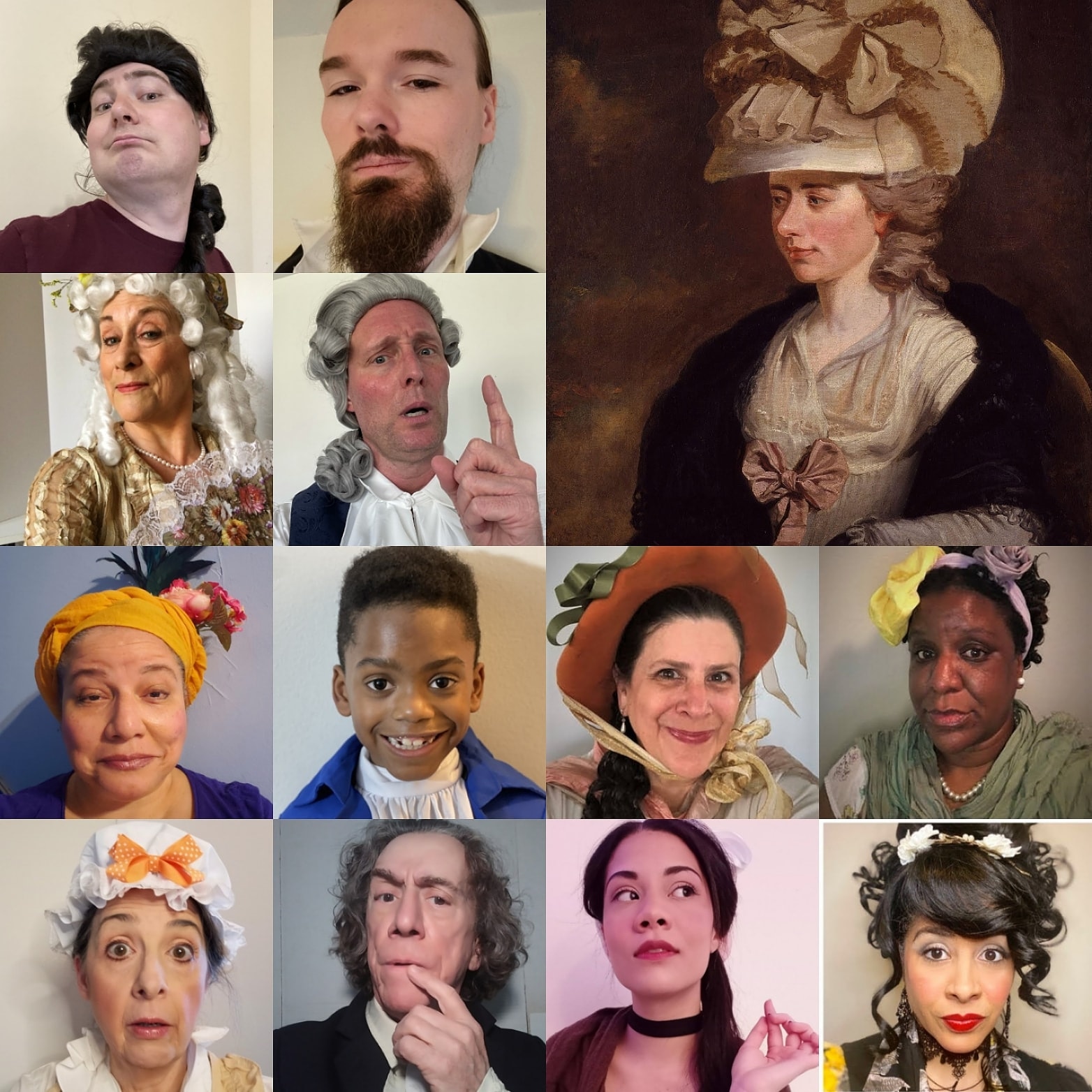
Image courtesy of Karen Eterovich.
As Burney did not get the chance to edit The Witlings for the stage, its running time comes close to four hours. Director, script editor and actor Karen Eterovich designed the performance as a mini-series, live-streamed in two sittings, with on-demand recordings available to viewers in the week. Despite the generous time, Eterovich still had to cut the role of Mr. Codger, father to Beaufort and his half-brother Jack, but to no real detriment to the success of the performance.
The team had some technical issues, streaming from the UK and US simultaneously, and many of the lines echoed in the background––there was even a dog barking at one point––but the actors, ever professional, carried on, undeterred. The power-point scene changes had to be loaded up manually, with the mouse suddenly appearing on the screen. But such problems just bring the audience closer. Many of us are so used to working and communicating with faces on our screens now, asking people to turn their mics back on, dealing with audio feedback, or waiting patiently while a colleague attempts to share their screen. These little issues actually recreate the human element we miss so much from the theatre.
The performance managed to capture the element of fun from Burney’s work. Imagine your family and friends grabbing props from around the house, pulling on wigs and working out how these characters interact from the script. Despite the difficulties and limitations of live Zoom theatre, there is a human authenticity in this performance that captivates the audience, as we enjoy some comic theatre in our own homes. This production of The Witlings enabled UK and US actors to join together in performing one of Burney’s relatively unknown but quintessential comedies. While the slight delay may have caused some extra dramatic pauses and late entrances, there is something so welcoming about a performance like this. While online theatre cannot reproduce the atmosphere of the physical theatre––one I feel we have almost forgotten, but hopefully will soon be reacquainted with––these animated faces on our screens bring the theatre into a new personal space.
The satire focusses on the pretended intellectuals of the Esprit Club, the literary critic, Lady Smatter (Kay Francksen), the self-confessed poet Mr. Dabler (Frank Farrell), and eager-to-please busybody, Mrs. Sapient (Emma Palzere-Rae). The main storyline hinges around the two overly dramatic lovers, Beaufort (Will Jesmond de Clermont) and Cecilia (Marsha-Ann Hay), and the will of wits between Lady Smatter and Mr. Censor (Richard Width), a close friend to Beaufort. When Cecilia loses her fortune, Lady Smatter disowns her, and forbids her nephew Beaufort from marrying her. Censor, despite his cutting wit and continual degradation of the Esprit club members, turns out to be the hero of the piece, and secretly takes Cecilia under his protection, reuniting her with the hopelessly-in-love Beaufort.
Alongside the overly dramatic characters of the upper ranks, Burney features several working-class women in her play: Mrs. Voluble (Denise Alessandria Hurd), a gossip-loving landlady; Mrs. Wheedle (Yolanda Hamilton), dress-shop owner and milliner; her main hand, Miss Jenny (Ashley Oviedo), and her two apprentices, Miss Sally (Kay Francksen) and Miss Polly (Karen Eterovich). Whenever these ladies were on screen––even when they were not talking––they kept themselves busy with props and, despite the limits of Zoom, managed to give the impression of side glances and knowing looks to each other, especially when Mrs. Sapient came looking for gossip about her crush, Mr. Dabler. A character who made the most of Zoom was the bumbling-but-busy Jack, played by Sam O’Sullivan, who had wonderfully abrupt entrances and exits, suddenly appearing back on screen to interrupt the scene. Special mention must be made to Cameron Keitt, who played a very young and endearing Bob, the comically-mistreated son of Mrs. Voluble. All of the supporting roles were no less present in this performance, and the ensemble came together beautifully––despite having to rehearse their lines separately. Lady Smatter, Censor and Dabler gave particularly outstanding performances.
As pointed out by Patrick Young[2], each character in The Witlings is so concerned with their own business, that they often miss the obvious solutions to their problems, simply through lack of communication. The lovers, incidentally, merely needed to talk to each other, to reveal Lady Smatter and Censor’s manipulations. This crucial element of the play, responsible for driving the story and drawing out the play’s satirical humour, is all the more exaggerated by the Zoom platform––while the characters are not able to talk over one another, they speak their lines in their own, isolated boxes, reproducing Burney’s subtle comedy with original technique.
The resourcefulness and ingenuity of online theatre has generated completely new ways to perform. While companies have had to adapt to its limitations, they have also thought of creative ways to use this platform to their advantage. Camera closeups were used to establish the asides, and with great success. Pieces of paper handed across frames as notes and letters, magically changing colour and shape, and Voluble holding her hand out for a greeting from Censor, only to be completely ignored, created extra levels of comedy.
The two live performances were followed by an informal chat with the actors and production team. They invited questions from the audience, but also talked about how they had to adapt in the pandemic. Director Eterovich said, “we had everything taken away from us, we had our theatres taken away from us. We started figuring out Zoom––it’s this whole interesting thing of trying to figure out how you look on camera, how to create a performance. We can figure it out, and we can make a play”. Richard Width (Censor) joined in, saying “artists have been so capable of being resilient in ways I don’t think they imagined they could be. As artists that’s part of how we survive this career path… we develop hardened resiliency.”
The openness and inclusivity of the online platform has allowed international performances to take place, with actors, production, directors, and the audience, scattered across the globe. Those unable to travel to watch a play, or even perform in a play, are now able to participate. What has most impressed me over the last year or so, is the amount of theatre companies that are finding rarely-performed works, especially those written by women, and being able to perform them without fear of profits and overheads. For this reason, I believe that the end of the pandemic will not be the end of Zoom theatre. And I hope, as many of the cast also indicated that through these platforms, through audience feedback and attendance, we can start to challenge the business of theatre and demand the opportunities to perform these lesser-known, but fascinating, ingenious and inciteful plays by women writers. As Eterovich questioned in the post-play discussion, “how many productions of Hamlet do I need to see?”
[1] See Frances Burney, The Witlings and the Woman Hater, ed. by Peter Sabor and Geoffrey Sill (London and New York: Routledge, 1997, 2016), pp. xiii–xviii.
[2] Frances Burney, The Witlings: Acting Version, adapted by Patrick Young (2012–2014), https://source.sheridancollege.ca/cgi/viewcontent.cgi?referer=https://www.google.com/&httpsredir=1&article=1000&context=faad_visu_book [accessed 4 May 2021]