
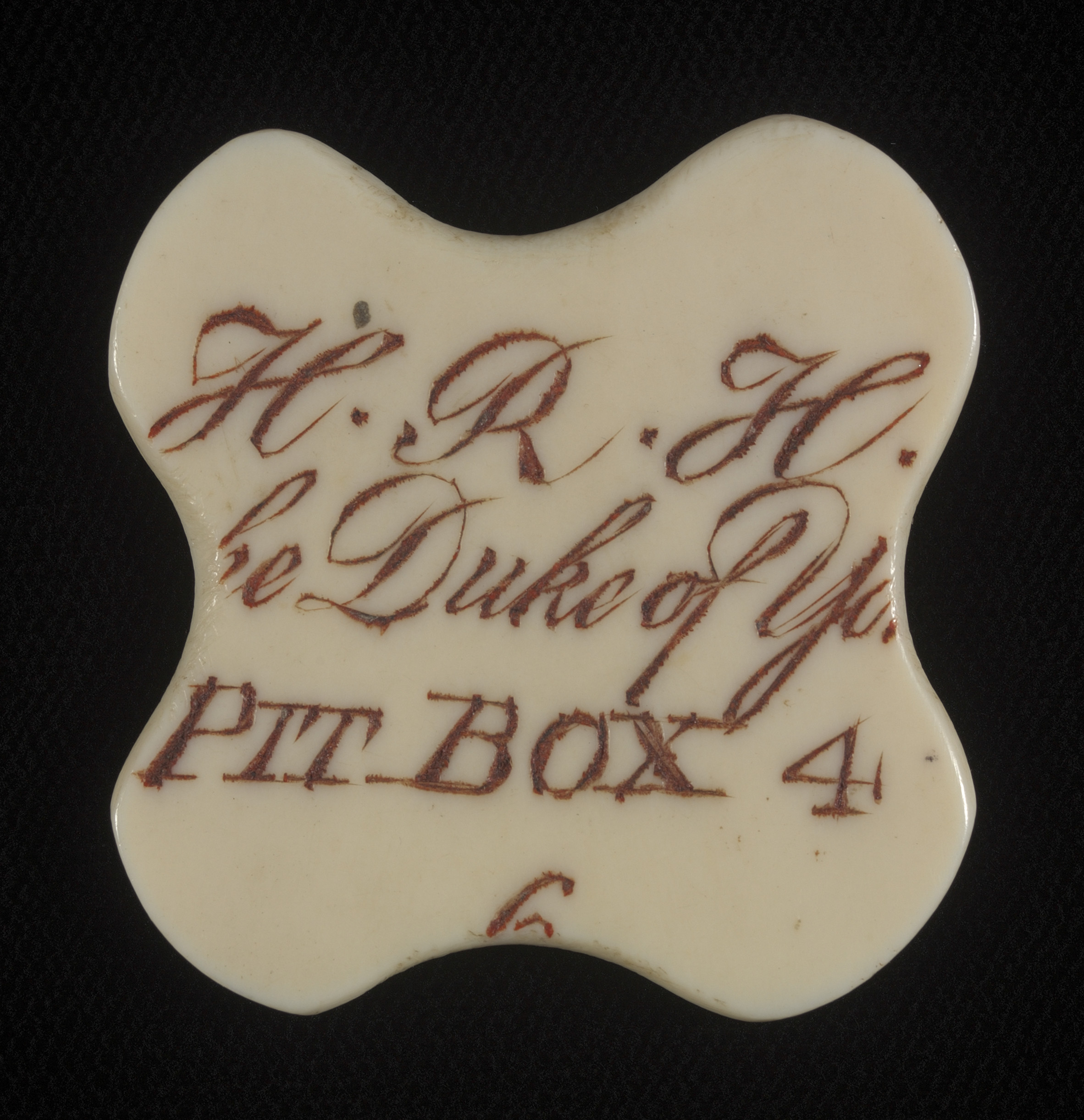
On entering the Foundling Museum, I was handed a postcard printed with a Georgian theatre ticket. As a souvenir of the museum experience, the postcard-ticket is one of several touches throughout the recently opened exhibition that encourage visitors to consider the similarities between theatre-going in the eighteenth century and our modern practices of cultural consumption. Inside the exhibition, a collection of tickets and tokens, including the Duke of York’s 1804 ivory token for his box at the King’s Theatre opera, introduce the experience of going to a show in Georgian Britain through its objects.
Tickets were often designed by celebrated engravers such as Francesco Bartolozzi, several of whose designs are on display, and they were commonly preserved as souvenirs. More than aesthetic objects, however, tickets—sometimes printed in black for men and red for women, or granting admission to either one gentleman or two ladies—afford insight into the practical aspects of theatre-going. Claiming to be a how-to guide to the Georgian theatre, the exhibition gives information on how and where tickets could be purchased as well as the cost. The displayed playbills tell us about the marketing of entertainments in an increasingly crowded sector with new bills appearing daily to drum up business by counting down the remaining nights of a production. Like tickets, they are rich if perplexing sources of information with one example instructing gentlemen on the correct parking of their carriages in front of the theatre. Another notifies ladies of when they should send servants to reserve seats whilst failing to mention the time of the performance.
After all, the actual performance was a secondary consideration for many patrons, and the exhibition does an excellent job of presenting the Georgian theatre as a busy space of social interaction—a place to see and be seen. A series of caricatures representing a lady of ill repute dressing to attend a concert at the Pantheon takes aim at the loose morals and vanity on display whilst the curator’s note adds that the high ceilings at the Pantheon made it a particularly advantageous stage for modelling the latest towering hairstyles. A replica of a lady’s pocket is presented alongside a collection of theatre-going paraphernalia including spy glasses, vials for smelling salts, and the ingenious Jealousy Glass which featured an oblique mirror and lateral aperture that allowed the user to sneak a sideways glance at their neighbours. The early nineteenth-century French model on display discreetly accommodates a pill holder and scent bottle. To further aid the lady in her spying, the theatres also produced souvenir paper fans at the start of the season printed with the layout of the audience and including the names of all the box holders. Three such fans are on display and are a highlight of the exhibition.
The exhibition aims to be immersive. Passages from Carl Philip Moritz’s Journeys of a German in England paint an amusing picture of British audiences’ misbehaviours: chattering through the performance, throwing orange peel, heckling actors. A section on audience comfort—or lack of—includes wonderfully detailed engravings of theatre interiors and seating arrangements, commissioned by managers as illustrations of the various improvements made to attract patrons. The text accompanying these images, however, evokes the ache of sitting for too long on backless benches in the pit whilst the heat inside the densely packed theatres could reportedly become overwhelming. Brightly coloured and boisterous caricatures by Thomas Rowlandson depict packed audiences of corpulent bodies and the hasty application of smelling salts to nostrils in need. Managers responded with competing claims that their theatre was ‘the coolest in town’.
Rowlandson’s satirical prints are also important for understanding the segregation of classes within the theatre and the bristling tension between different sections of the audience. Among the prints on display is Rowlandson’s claustrophobic image of the ‘pigeon holes’ into which servants were squeezed above their employers’ boxes. William Hogarth’s The Laughing Audience illustrates the spikes dividing orchestra and pit that were installed for crowd control. Other images show the riots that broke out in Covent Garden Theatre in 1763 when the theatre ended a policy that had offered half price admission to the second act. Riots broke out again in 1809 against the rise in ticket prices.
The exhibition also peeks backstage to explore the uses of scenery and stage mechanics as well as the role of the theatre manager whose business comprised a difficult balancing act of commerce, art and safety. Fire was a common occurrence in eighteenth-century theatres, which is little surprise when we learn that at the Covent Garden Theatre, where the chandeliers were particularly impressive, the bill for candles was second only to the performers’ salaries in the yearly running costs.
The multi-angled approach is continued through the rest of the exhibition which looks at three further entertainments—music festivals, the annual benefit concert given at the Foundling Hospital Chapel, and the Vauxhall Pleasure Gardens. With fewer prints and objects on display, these smaller sections prove less immersive than the magpie’s nest of the Georgian theatre but continue to develop important narratives of eighteenth-century show business. The music festivals, large-scale concerts often held over several days and with a ball given at the end to celebrate, required especially vast efforts of organisation. They also encouraged the spread of musical culture from London to the provinces, and the ornate souvenir programmes produced for an event such as the festival at York Minster suggest the significance of the music festival within the local calendar.
Benefit concerts were also popular, satisfying a taste for both philanthropy and musical entertainment. In 1749, Handel offered a benefit concert for the Foundling Hospital to support the completion of the partially built chapel. Invited back the next year, the composer performed his Messiah in the chapel. The long, sacred work had hitherto failed to gain traction within the London music scene, but in this setting it was an outstanding success and Handel continued to perform it for the benefit of the Hospital every year until his death in 1759. The exhibition thus offers an interesting introduction to the Gerald Coke Handel Collection, housed at the museum, which holds over 12,000 items relating to Handel and his contemporaries, and is a rich resource for the study of eighteenth-century music. The benefit concert not only played a significant role in British musical culture, however, but also in the history of the Foundling Hospital and its continuing life as a museum today. Placing the benefit concert in relation to other forms of eighteenth-century entertainment and display, the curators draw out the relationship between art, charity and social performance. Many of the festivals also had a charitable cause attached since, as Handel’s Anthem for the Foundling Hospital, composed for the inaugural 1749 concert, reminds us, ‘blessed is he that considereth the poor’. The score of the anthem is on display, bringing show business and charity, fashionable society and the mothers and children that the hospital served together in one object.
The section exploring the Pleasure Gardens at Vauxhall similarly collects together many strands of the exhibition. The different classes have been released from their confinement within the theatre to mix in the open air. A ticket to the Gardens for May 1792 encapsulates the mood of Arcadian license: a young woman in dishabille appears as a sort of woodland nymph with an ivy-wound staff in one hand and a mask in the other. A hand-coloured engraving by Robert Pollard after Rowlandson depicts the Gardens and is a who’s who of the 1780s social scene; identifiable amongst the crowd are the Prince Regent, his mistress the actress Mary ‘Perdita’ Robinson, and a surprisingly jolly Samuel Johnson. On view for the first time in more than 200 years, a supper box painting by Francis Hayman, Devil to Pay, is displayed within a reconstruction of such a box. It depicts the actress Kitty Clive in the role that made her famous in Charles Coffey’s ballad opera of the same name. Theatre, celebrity and contemporary art meet here.
This is a highly informative exhibition that puts material culture into action, but it requires some work on the part of the visitor. Consequently, anyone hoping to make a quick dash through might be disappointed. Set aside the time to engage with the exhibits, however, and your efforts will be rewarded.
Two Last Nights! is at the Foundling Museum, London from 20 September 2019 to 5 January 2020.